
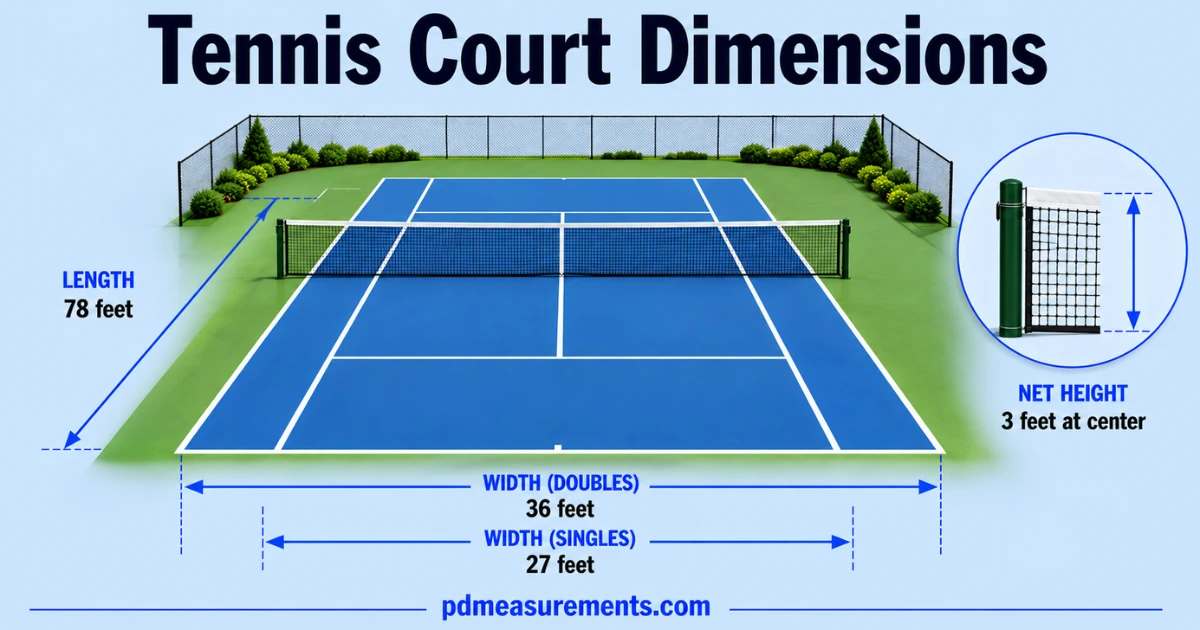
A regulation tennis court is 78 feet long. Width changes based on the game — 27 feet for singles and 36 feet for doubles. This guide breaks down every tennis court dimension, from lines and net height to backyard build costs.
What Are the Official Tennis Court Dimensions?
The International Tennis Federation (ITF) sets the global rulebook for tennis court dimensions. In the U.S., the United States Tennis Association (USTA) follows these same specs for every level of play.
These numbers never change, no matter the surface or location.
Tennis Court Dimensions in Feet and Meters
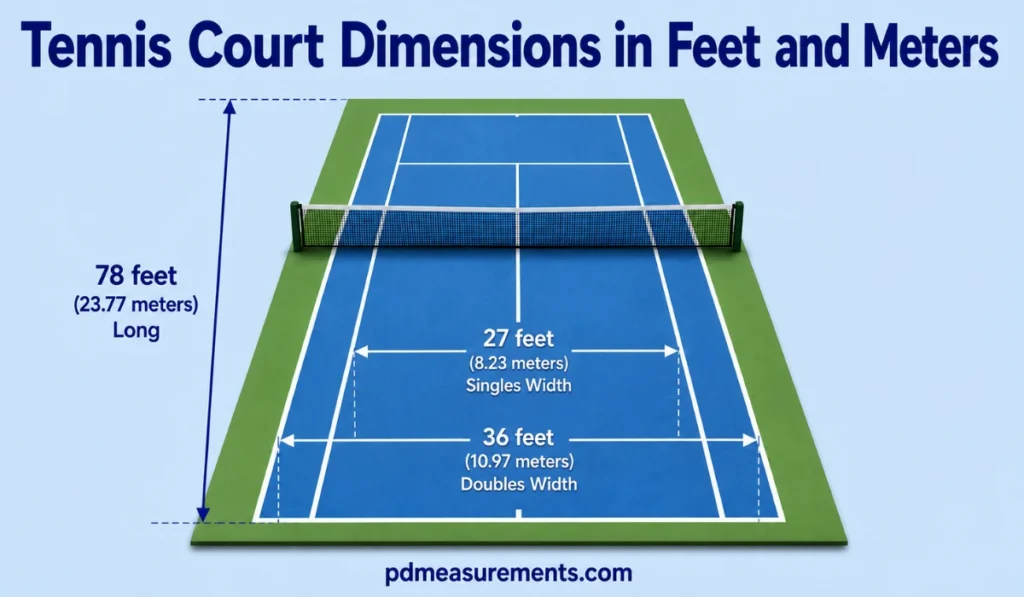
Most American players think in feet. Most of the rest of the world thinks in meters. A standard court is 78 feet, or 23.77 meters, long.
Singles width comes to 27 feet (8.23 meters). Doubles width comes to 36 feet (10.97 meters). Knowing both units helps when you’re reading international court plans or ordering equipment.
More Post: Standard Pillow Dimensions: Complete Sizes, Width & Height Guide
Singles vs. Doubles Court Dimensions
Tennis Court Dimensions for Singles
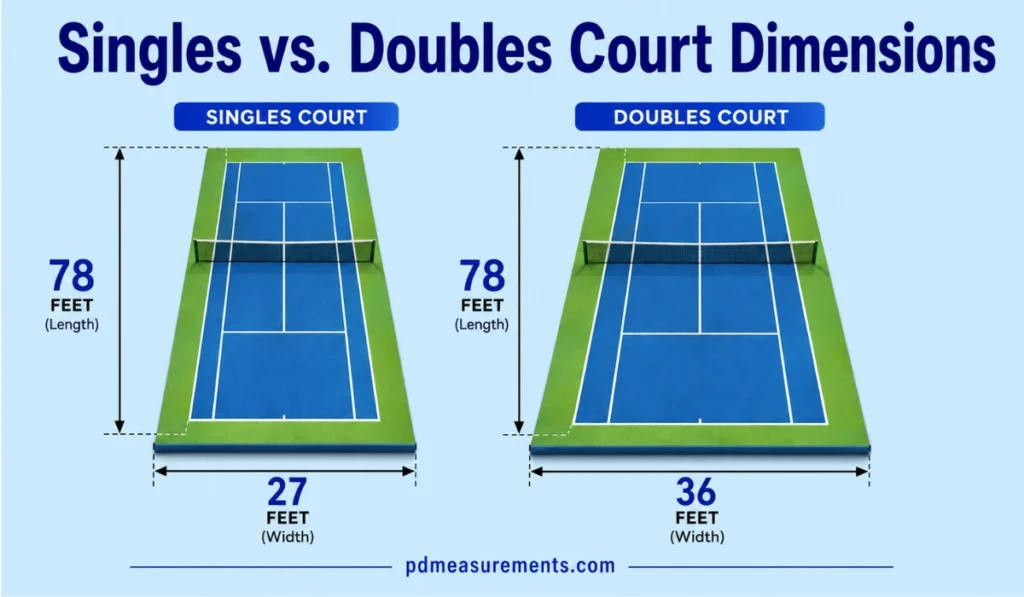
A singles court measures 78 feet by 27 feet. Players use only the inner sidelines — the outer alleys are out of bounds.
Tennis Court Dimensions for Doubles
A doubles court keeps the same 78-foot length but widens to 36 feet. That extra width comes from the alleys on each side.
What Is the Doubles Alley?
The doubles alley is a 4.5-foot strip running along each sideline. It’s only in play during doubles matches, adding 9 extra feet of total width to the court.
Tennis Court Layout: Lines, Boxes, and Markings Explained
Baseline and Sidelines
The baseline is the back boundary where most serves and groundstrokes happen. Sidelines run the length of the court and mark the width — inner lines for singles, outer lines for doubles.
Service Line and Service Boxes
The service line sits 21 feet from the net on each side. It creates the service boxes, where every legal serve must land.
Center Service Line and Center Mark
A center service line splits each side into two service boxes — the deuce court and the ad court. The center mark, a short 4-inch hash on the baseline, tells a server which side to stand on.
Standard Width of Tennis Court Lines
Court lines must be at least 2 inches wide. The baseline can go up to 4 inches wide for better visibility from a distance.
Net Height Dimensions on a Tennis Court
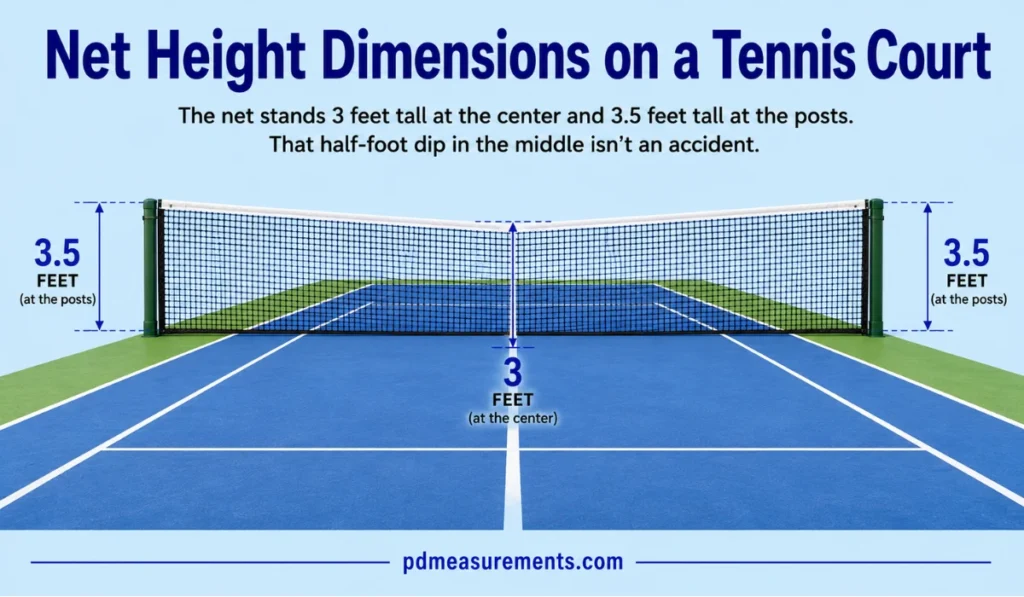
The net stands 3 feet tall at the center and 3.5 feet tall at the posts. That half-foot dip in the middle isn’t an accident.
Players are taught to hit cross-court because the net is lower there. It’s a small detail with a big effect on strategy.
How Much Space Is Needed for a Tennis Court?
How much room do you need for a tennis court? The playing surface alone needs 78 x 36 feet, but the full footprint is much bigger once you add safety space.
Minimum Runoff Space (Sidelines and Baseline)
Leave at least 12 feet from each sideline to a fence or wall. Behind each baseline, leave a minimum of 21 feet of clear runoff space.
Total Court Footprint (Including Runoff)
Once runoff is added, the standard total footprint becomes 120 feet by 60 feet. That’s roughly 7,200 square feet of usable land.
Overhead Clearance for Indoor Tennis Courts
Indoor courts need 20 feet of clearance above the baseline. Above the net, that clearance jumps to 35 feet to allow for high lobs.
Tournament and Stadium Court Dimensions
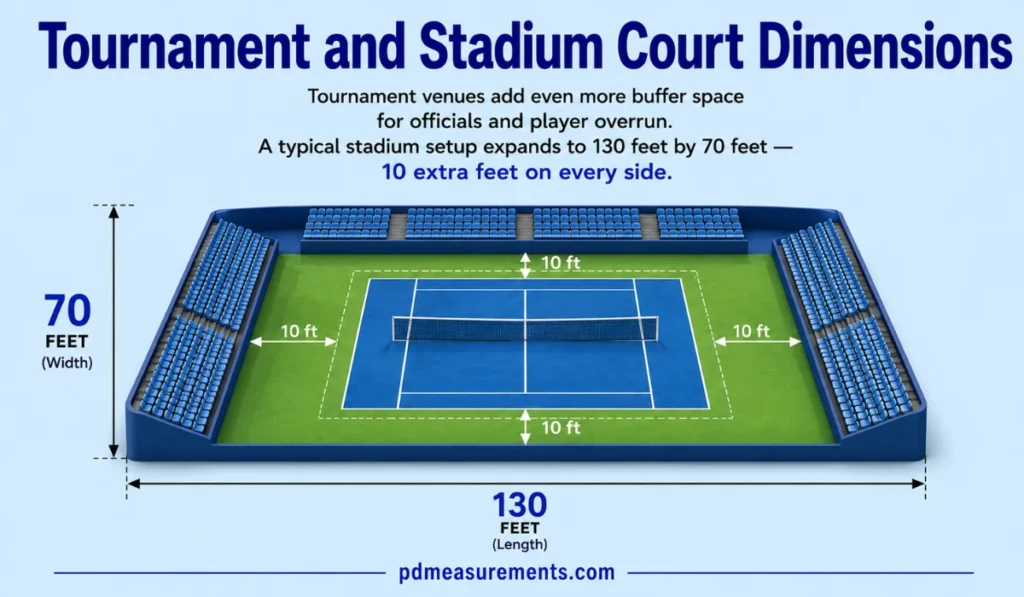
Tournament venues add even more buffer space for officials and player overrun. A typical stadium setup expands to 130 feet by 70 feet — 10 extra feet on every side.
This extra room isn’t required for casual play but matters at the competitive level.
Junior Tennis Court Dimensions
Kids don’t need a full 78-foot court to learn the game. The ITF’s 10 and Under Tennis program uses three smaller court sizes.
A Red Ball court measures just 36 feet by 18 feet, with a 2 ft 9 in net. Orange Ball courts grow to 60 feet by 21-27 feet, while Green Ball play happens on a full-size court with a regular ball swap.
Tennis Court Surfaces and How They Affect Play
Hard Courts
Hard courts use concrete or asphalt topped with acrylic paint. They offer a medium ball speed and a consistent, predictable bounce.
Clay Courts
Clay courts are made from crushed brick or shale. They slow the ball down and produce a higher bounce, which favors patient, tactical players.
Grass Courts
Grass is the fastest surface in tennis. The bounce is low and sometimes unpredictable, rewarding quick reflexes and aggressive net play.
Cushioned Acrylic Courts
These courts add a cushioned layer beneath the acrylic top coat. They reduce joint impact while keeping ball speed in the medium range.
Surface type never changes the official tennis court dimensions — only how the ball behaves on it.
Tennis Court vs. Pickleball Court Dimensions
A pickleball court measures just 44 feet by 20 feet — a fraction of a tennis court’s footprint. You can fit close to four pickleball courts inside the space of one full tennis court with runoff.
Can You Play Pickleball on a Tennis Court?
Can I play pickleball on a tennis court? Yes. Many facilities simply tape or paint pickleball lines inside the existing tennis boundaries, letting one space serve both sports without any structural changes.
Frequently Asked Questions About Tennis Court Dimensions
How much room do you need for a tennis court?
You need roughly 120 feet by 60 feet total, including the 78×36-foot playing surface plus runoff space on all sides.
Can I play pickleball on a tennis court?
Yes, pickleball lines can be added directly onto a tennis court without changing its structure or dimensions.
What is the cheapest way to build a tennis court?
Asphalt with a basic acrylic surface coating, minimal fencing, and no added lighting is typically the most budget-friendly build option.
What are the boundaries of a tennis court for singles?
A singles court’s boundaries are the inner sidelines and baselines, forming a 78-foot by 27-foot rectangle.
How much would it cost to build a tennis court in your backyard?
Most backyard builds cost between $30,000 and $80,000, depending on surface choice, land prep, and added features like lighting or fencing.
Does a tennis court add value to a property?
It can boost buyer appeal in markets where tennis is popular, but the resale value impact depends heavily on location and the local buyer pool.

Rehmaan Khan is a Measurement Content Researcher Specializing in PD measurements, Size Guides, Charts, and Simple Educational Measurement Content.