
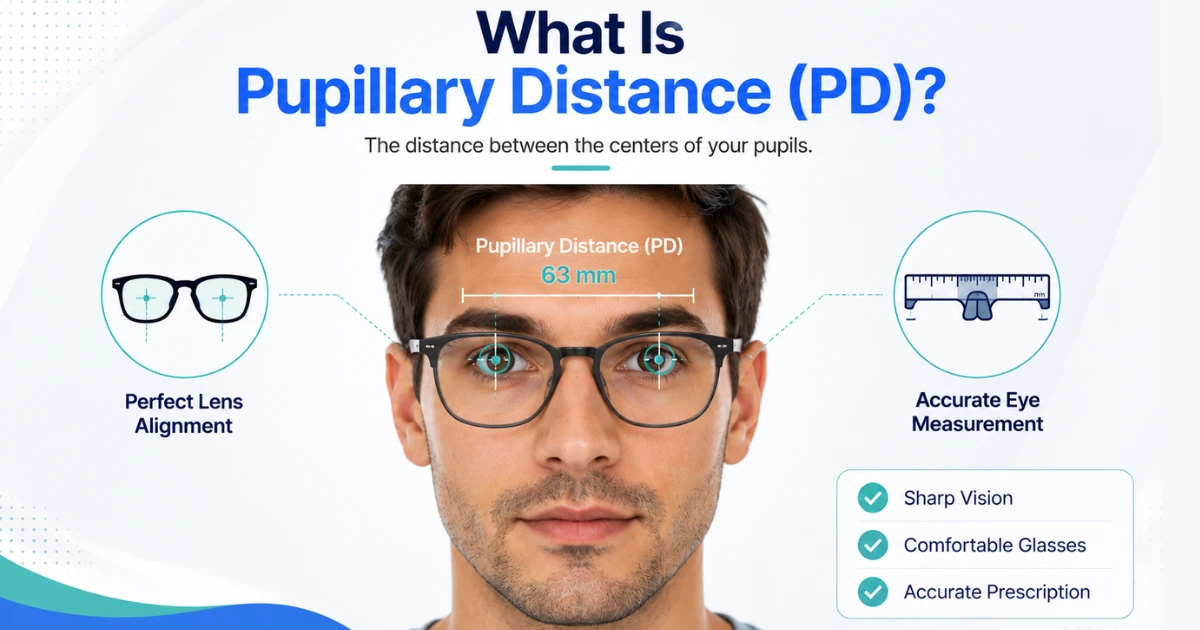
Pupillary distance, also called interpupillary distance (IPD), is the space between the centers of your two pupils. It’s measured in millimeters (mm).
Lens makers use this number to line up the optical center of each lens with your eyes. Get it right, and your vision feels sharp and natural.
Get it wrong, and light bends through the wrong part of the lens. This creates what eye doctors call induced prism — a small but real distortion that can cause eye strain, headaches, and blurred vision.
Single PD vs. Dual PD: What’s the Difference?
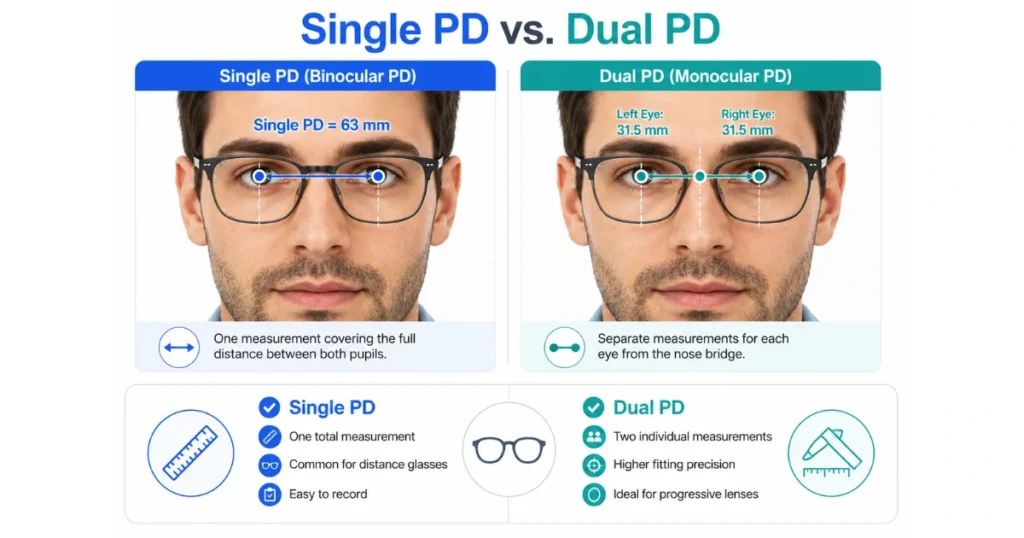
Single PD, also known as binocular PD, is one number covering the full distance between your pupils. Most people quote this version — something like “63mm.”
Dual PD, or monocular PD, measures each eye separately from the bridge of your nose. It’s written as two numbers, like 32/30, where the first is your right eye (OD, or oculus dexter) and the second is your left (OS, or oculus sinister). Dual PD is often more precise, since most faces aren’t perfectly symmetrical.
What Is a Normal Pupillary Distance?
Most adults fall between 54mm and 74mm. Research from optical retailers shows men often measure slightly wider, around 55mm to 70mm, while women typically measure 53mm to 65mm.
Children’s PD is smaller, usually landing between 43mm and 58mm, since their faces are still growing.
There’s also a difference between distance PD and near PD. Your eyes turn slightly inward when you focus up close, so your near PD (used for reading glasses) runs about 3mm smaller than your distance PD.
Why Isn’t PD on My Prescription?
Under the FTC Eyeglass Rule, eye doctors in the U.S. are only required to give you your prescription — sphere, cylinder, and axis. PD is not legally part of that requirement in most states.
Only a handful of states — Alaska, Kansas, Massachusetts, and New Mexico — currently require PD to appear on the prescription itself. Everywhere else, it’s treated as a separate fitting service, which is why some offices charge extra for it or simply leave it off.
Pupillary Distance-FAQ’s
Why is my PD not on my prescription?
Because federal law doesn’t require it. The FTC Eyeglass Rule only mandates your lens prescription, not your PD. Some states require it anyway, but most don’t.
How do I find my PD for glasses?
Ask your eye doctor directly, check your printed prescription for a “PD” field, or measure it yourself with a ruler, a marker method, or a phone app.
What happens if my PD is off by 2mm?
A 2mm error can cause noticeable eye strain, headaches, or blurry vision, especially with strong prescriptions or progressive lenses. Mild single-vision glasses may still feel wearable, but comfort usually drops.
What is a normal pupillary distance?
Most adults measure between 54mm and 74mm. Children typically fall between 43mm and 58mm.
Can an eye doctor refuse to give you your PD?
Yes, in most states this is legal, since PD isn’t part of the required prescription under the FTC Eyeglass Rule. You can still measure it yourself or ask a different provider.
Is it okay if my PD is off by 1?
A 1mm difference is usually minor and often tolerable for basic single-vision lenses. For progressive lenses or higher prescriptions, even 1mm can cause mild discomfort over time.