
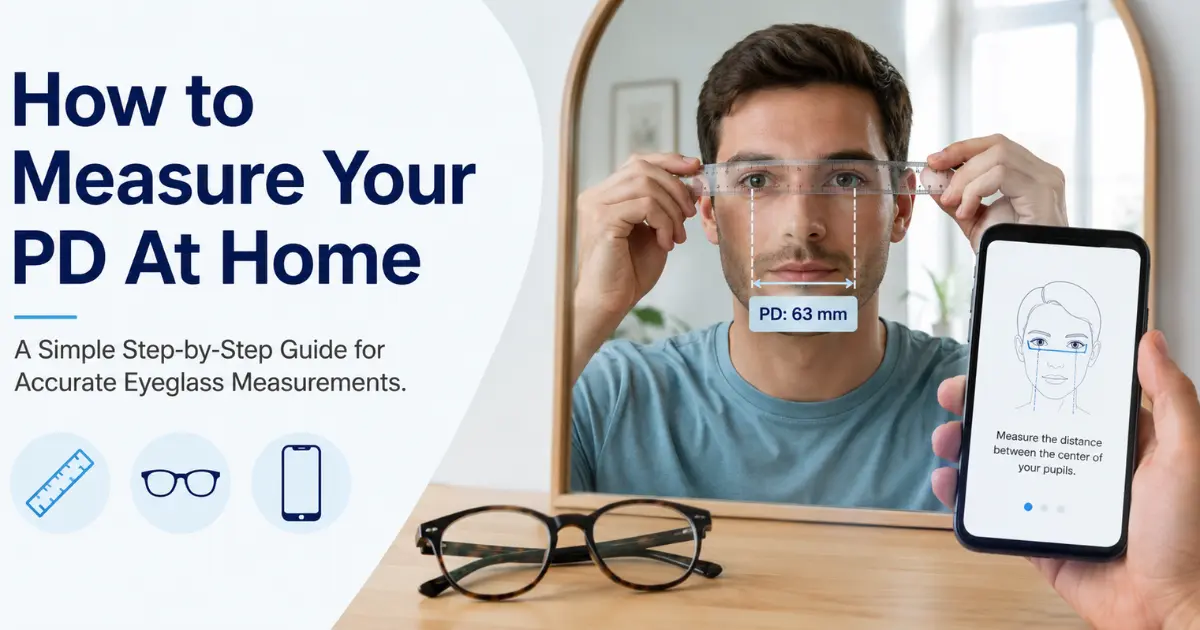
You can measure your PD at home in under five minutes, using nothing but a mirror, a ruler, or your phone.
What Is Pupillary Distance (PD)
Pupillary distance, or PD, is the space between the centers of your pupils. It’s measured in millimeters. Doctors also call it interpupillary distance.
How to Measure Your PD at Home
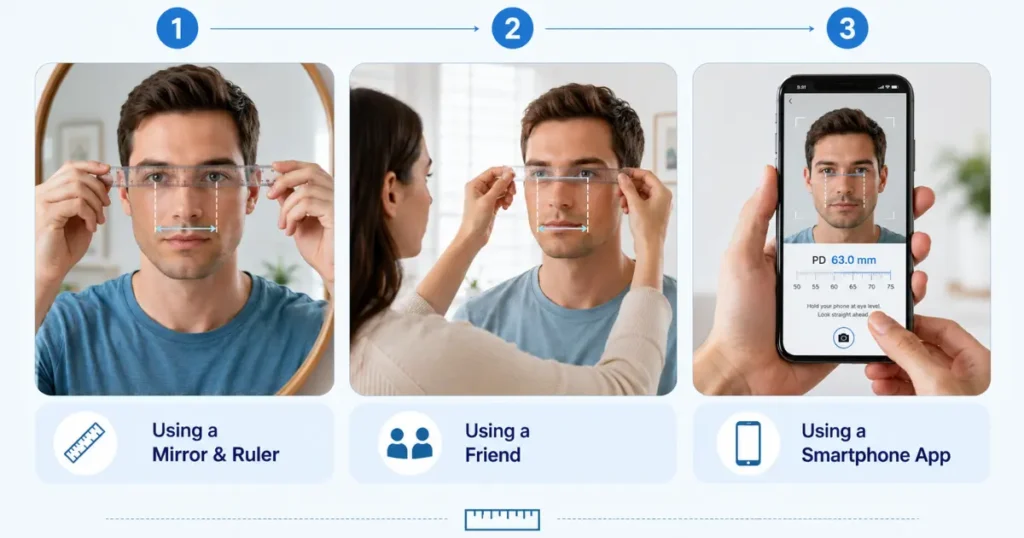
There are three reliable ways to measure your PD at home. Each works well. Pick whichever feels easiest for you.
- Using a mirror and ruler: Stand about 8 inches from a mirror. Hold a millimeter ruler across your brow line. Close your left eye and line up zero with your right pupil’s center. Then close your right eye and read the number over your left pupil’s center.
- Using a friend: This method is often more accurate, since someone else reads the ruler instead of you. Sit still and look at a point 10 to 20 feet away. Have your friend hold the ruler across your eyebrows and align it the same way.
- Using a smartphone app: Apps like Opthy and EyeMeasure use your phone’s camera and facial recognition to calculate PD automatically. You’ll usually hold a credit card near your face for scale. This method is fast, but ruler measurements remain the gold standard.
Single PD vs. Dual PD vs. Near PD
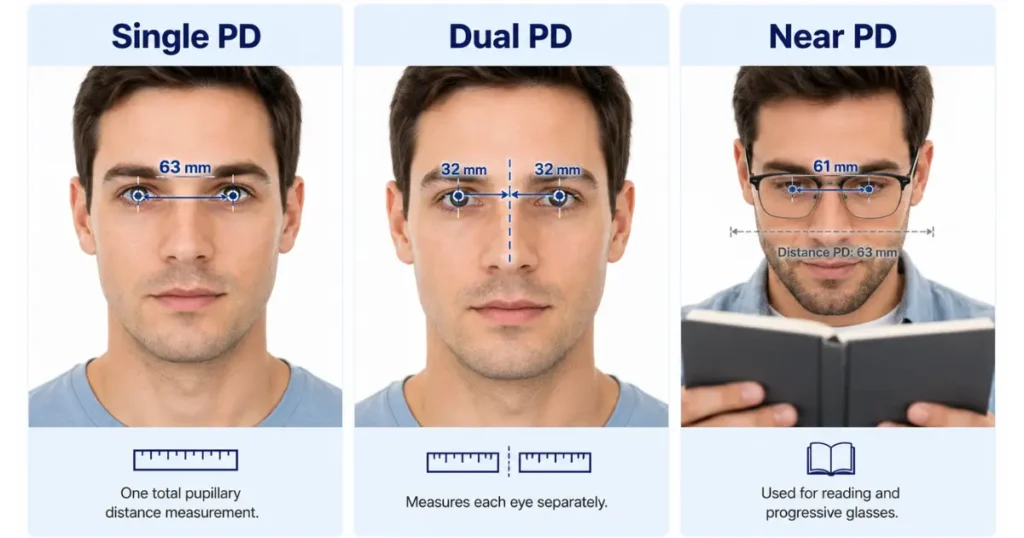
- Single PD is one number — the total distance between your two pupils. Most people have a single PD between 54mm and 74mm.
- Dual PD splits that number in two: one measurement from each pupil to the center of your nose bridge. It’s written as two numbers, like 32/31, with the right eye listed first.
- Near PD is used for reading glasses, bifocals, and progressive lenses. It measures your eyes’ focus point up close, which sits slightly closer together than your distance PD.
Your PD Number
Average PD for adults falls between 54mm and 74mm. Women average around 60-62mm, while men average closer to 64mm. Children typically measure between 43mm and 58mm, since their skulls are still developing.
Look for your PD in the section labeled “PD” or “pupillary distance” on your prescription, separate from your sphere, cylinder, and axis numbers.
A margin of 1mm is usually fine. Most people won’t notice a difference that small. But once the gap hits 3mm or more, expect symptoms like blurred vision, eye fatigue, or headaches, especially in stronger prescriptions.
Question’s
How do I measure my PD without a ruler?
You can use a smartphone app that relies on your camera and a credit card for scale, or ask an optician to measure it for you at no cost during a store visit.
Can I find my PD on my glasses?
No. The numbers etched inside your frame’s arms refer to frame size, not your personal pupillary distance. Only a prescription or manual measurement gives you your actual PD.
Does my PD have to be exact?
Yes, ideally. A 1mm difference rarely causes issues, but accuracy matters more as your prescription strength increases.
Where is my PD on my prescription?
It’s listed in a dedicated “PD” field, separate from your sphere, cylinder, and axis values.
What happens if my pupillary distance measurement is off?
Your lenses’ optical centers won’t align with your pupils. This can cause blurred vision, eye strain, and headaches, particularly with strong or progressive prescriptions.
Does PD affect frame size?
No. PD shapes how your lenses are cut and centered, but it has no bearing on frame dimensions like width or temple length.
Does PD change over time?
It changes during childhood as the skull grows, then stays fairly stable through adulthood.
Is PD important for single vision glasses?
Yes. Every prescription lens, including single vision, depends on accurate PD to center the optical zone properly.
What is the difference between ‘single’ and ‘dual’ pupillary distance?
Single PD is one combined number for both eyes. Dual PD splits that measurement into two numbers, one per eye, measured from the nose bridge.
How to find pupillary distance?
Measure it yourself with a mirror and ruler, ask a friend to help, use a PD measurement app, or request it from your eye doctor.
What does PD mean for glasses?
PD tells the lens lab exactly where to place the optical center of each lens so you look through the clearest part.
Do you need the PD for sunglasses?
Only for prescription sunglasses. Non-prescription sunglasses don’t require a PD measurement at all.
What is the average pupillary distance?
Most adults fall between 54mm and 74mm, with women averaging around 60-62mm and men around 64mm.