
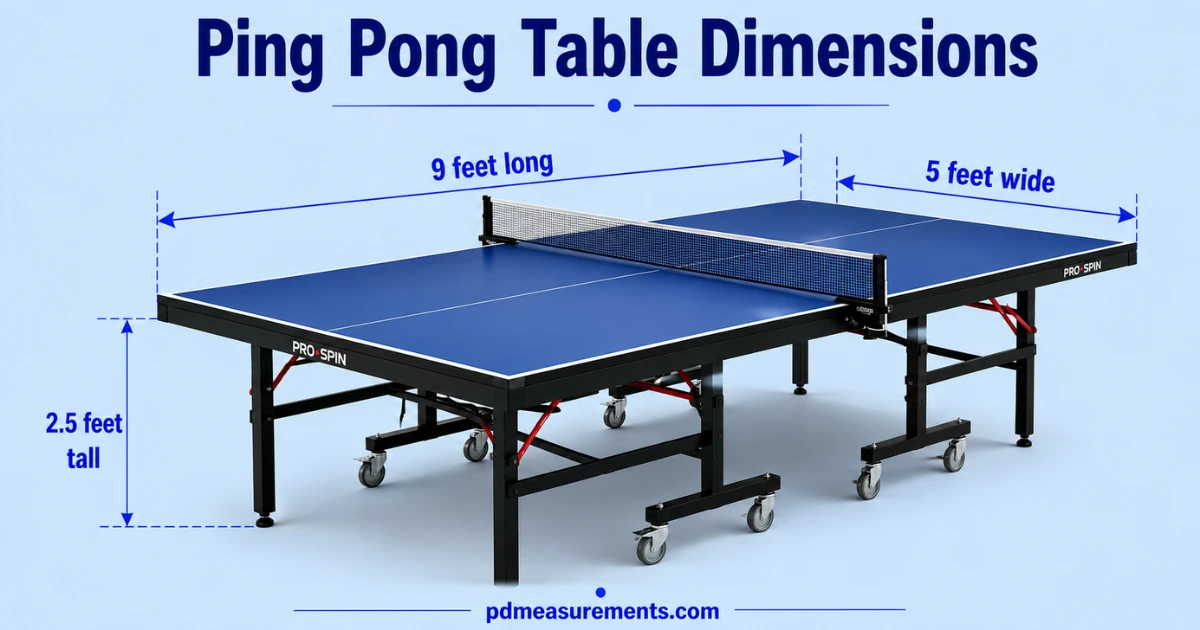
A regulation ping pong table measures 9 feet long, 5 feet wide, and 2.5 feet tall. This size is used in homes, clubs, and every sanctioned tournament worldwide.
This guide covers the official ping pong table dimensions, how much room you need, and every table type on the market. No fluff. Just the facts.
What Are the Standard Ping Pong Table Dimensions?
A regulation ping pong table measures 9 feet long, 5 feet wide, and 2.5 feet tall. This size is used in homes, clubs, and every sanctioned tournament worldwide.
These numbers never change. Whether you buy a $200 table or a $2,000 one, the playing surface stays the same size by law of the sport.
Ping Pong Table Dimensions in Feet vs. Meters vs. Centimeters
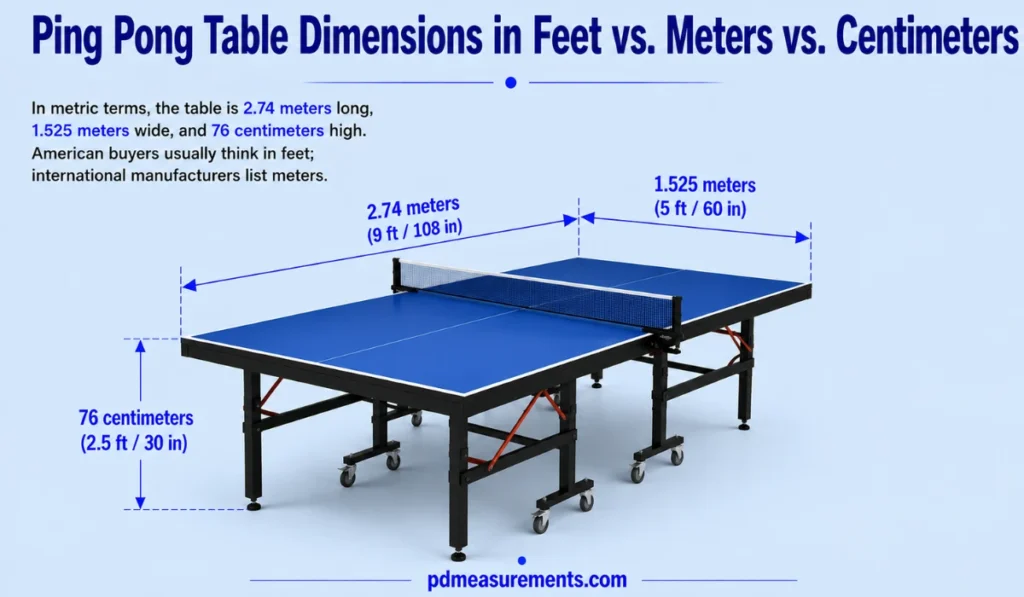
In metric terms, the table is 2.74 meters long, 1.525 meters wide, and 76 centimeters high. American buyers usually think in feet; international manufacturers list meters.
Here’s the quick conversion:
- Length: 9 ft / 108 in / 2.74 m
- Width: 5 ft / 60 in / 1.525 m
- Height: 2.5 ft / 30 in / 76 cm
Playing Surface Height Explained
The playing surface must sit exactly 76 cm above the floor. This height was chosen because it matches a comfortable hitting position for the average adult standing at the table.
Kids’ tables and junior tables often use this same height, even when the tabletop itself is smaller. That keeps gameplay consistent across sizes.
ITTF Ping Pong Table Dimensions and Official Rules
Why ITTF Sets the Standard
The International Table Tennis Federation (ITTF) governs the sport globally, including table specs. Every rule about size, bounce, and color traces back to this one organization.
According to the ITTF equipment rules, any table used in a sanctioned event must meet exact measurements. Home tables don’t have to comply, but most manufacturers build to these specs anyway for consistency.
Table Markings, Border Lines, and Center Line Specs
Regulation tables have a 2 cm white border line running along each edge. A 3 mm center line splits the table lengthwise for doubles play only.
These lines aren’t decoration. They define fair and out-of-bounds serves during doubles matches.
What “ITTF-Approved” Actually Means
ITTF-Approved is a certification, not just a size match. A table earns this label only after passing bounce tests, surface uniformity checks, and structural reviews.
Most home and office tables are regulation-sized but not officially approved, since certification adds cost that casual buyers don’t need.
More Post: Queen Bed Dimensions: Size, Types, Room Space & Mattress Thickness
Ping Pong Net Dimensions
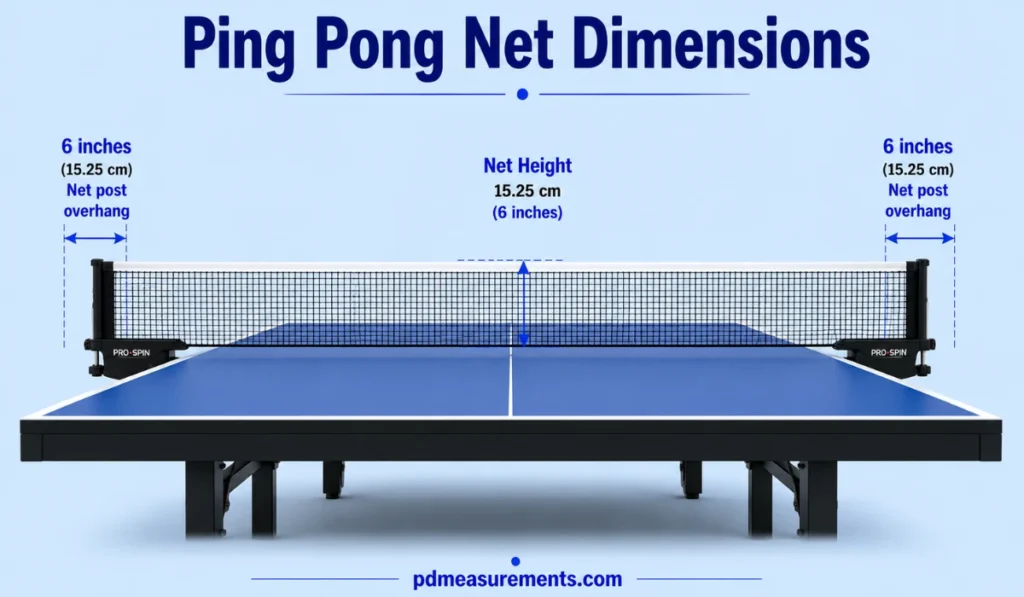
Net height is fixed at 15.25 cm, or 6 inches, across the entire width of the table. The net must stay taut with zero sagging in the middle.
Net posts extend 6 inches beyond each side of the table. This small overhang prevents sneaky edge shots from slipping past the net untouched.
Ping Pong Table Thickness and Surface Material
Common Thicknesses (12mm to 25mm) and What They Mean
Table thickness ranges from 12mm on entry-level tables to 25mm on tournament-grade models. Thicker tops mean better bounce consistency and a more durable surface over time.
The ITTF requires a minimum of 22mm for sanctioned competition. Anything below that is fine for casual play but won’t meet tournament rules.
MDF vs. Particleboard vs. Plywood Surfaces
Medium-density fiberboard (MDF) is the most common material because it’s affordable and bounces reliably. Particleboard is cheaper but wears faster.
Plywood and composite wood veneers show up on premium tables. They cost more but resist warping better in humid garages or basements.
How Thickness Affects Bounce and Ball Speed
A regulation ball must bounce 23 cm when dropped from 30 cm onto the surface. Thinner tables absorb more energy, so the ball bounces lower and play feels slower.
Thicker tables reflect more energy back, creating faster rallies and sharper spin response. This matters most for intermediate and advanced players working on technique.
How Much Space Do You Need for a Ping Pong Table?
Minimum Room Size for Recreational Play
How much space do you need around a ping pong table? For casual home use, aim for a room at least 19 feet long by 11 feet wide. That gives players enough room to step back and swing freely.
Anything smaller works but starts to feel cramped, especially during longer rallies. Measure your space with tape before buying.
Recommended Clearance on Each Side and Behind the Table
Leave at least 3 feet of clearance on each side of the table and 5 feet behind each end. This buffer lets players move for wide shots without hitting a wall.
Tighter clearance is workable for beginners, but it limits footwork as skill improves.
Space Requirements for Competitive or Tournament Play
Local tournaments require roughly 30 feet by 16.5 feet. National events need slightly more, and international matches call for a massive 46 feet by 23 feet enclosed playing area.
These numbers come directly from ITTF regulations for sanctioned play, not casual home setups.
Ceiling Height and Overhead Clearance (Often Overlooked)
Most buying guides skip this: ceiling height matters too. Lob shots and high serves need vertical room, so aim for at least 8 feet of clearance overhead.
Low basement ceilings or exposed ductwork can turn an otherwise perfect room into a frustrating play space.
Doorway and Hallway Width for Moving a Table Indoors
Before delivery, check that your doorways and hallways can fit a folded table through. Most folded tables measure around 3 to 5 feet wide, depending on the design.
Two-piece tables are easier to carry through tight spaces since each half moves separately.
Ping Pong Table Dimensions for Small Spaces
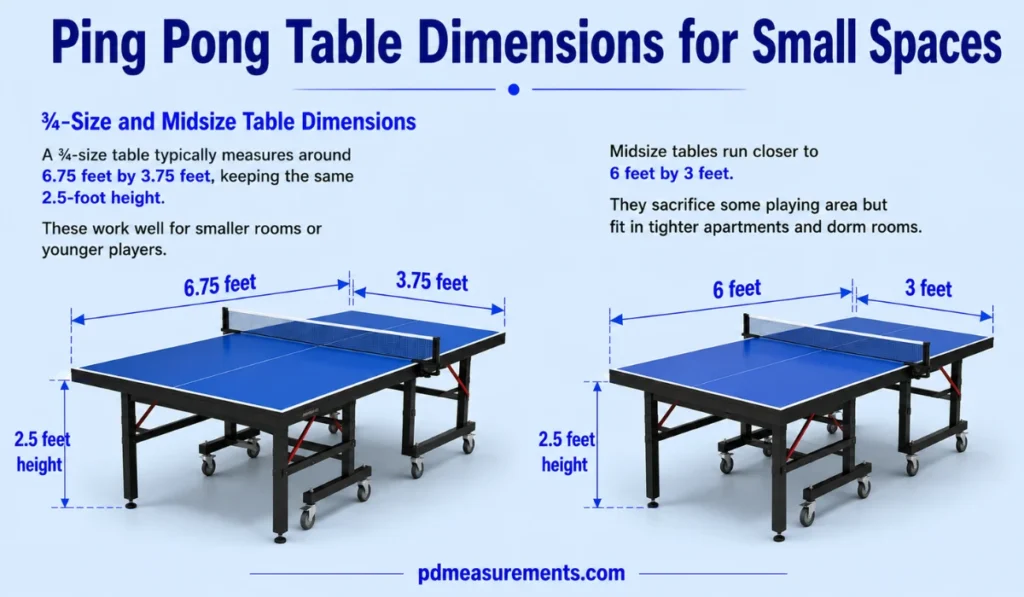
¾-Size and Midsize Table Dimensions
A ¾-size table typically measures around 6.75 feet by 3.75 feet, keeping the same 2.5-foot height. These work well for smaller rooms or younger players.
Midsize tables run closer to 6 feet by 3 feet. They sacrifice some playing area but fit in tighter apartments and dorm rooms.
Folding and Compact Table Options
Folding tables let you store the table vertically against a wall between games. This is the most practical solution for multi-purpose rooms like garages or home offices.
Two-piece folding designs stack flat against each other, saving even more storage space than one-piece models.
Conversion Top Dimensions (For Pool Tables)
A conversion top is a tabletop-only surface that sits on top of an existing pool table. Most conversion tops match regulation size, so you get full-size play without buying a separate frame.
This option works best if you already own a pool table and want to add table tennis without adding furniture.
Junior and Kids’ Ping Pong Table Dimensions
Standard Junior Table Sizes
Junior tables usually measure about 7 feet by 4 feet, roughly ¾ the size of a regulation table. The height typically stays close to standard at 2.5 feet.
This smaller footprint makes it easier for kids to reach across the table and develop proper form early.
Choosing the Right Table Size by Age
Younger children benefit from smaller, lighter tables that don’t overwhelm their reach or strength. As kids grow into their early teens, a full regulation table becomes more appropriate.
Consider a midsize or junior table first if the primary players are under age 10.
Indoor vs. Outdoor Ping Pong Table Dimensions
Do Outdoor Tables Differ in Size?
Outdoor tables keep the same regulation dimensions as indoor models. The size never changes; only the materials and coatings differ.
This means an outdoor table plays identically to an indoor one, just with better resistance to sun and rain.
Weather-Resistant Materials and Dimension Considerations
Outdoor tables often use aluminum composite tops instead of wood-based materials. Aluminum resists warping from moisture, which wood-based surfaces cannot survive outdoors long-term.
Legs and frames on outdoor models are usually galvanized steel, adding rust resistance without changing the table’s footprint.
Ping Pong Table Dimensions Comparison by Brand
Popular Brands and Their Standard Sizes (STIGA, JOOLA, Butterfly, Cornilleau, etc.)
Major brands like STIGA, JOOLA, Butterfly, and Cornilleau all build to the same 9×5-foot regulation standard. The real differences show up in thickness, frame quality, and folding mechanisms.
Butterfly, for example, offers ITTF-Approved models like the Centrefold 25 with a 25mm top, while entry-level STIGA and JOOLA tables often use 12-19mm tops for home use.
Quick Comparison Table (Dimensions, Thickness, Price Range)
Frequently Asked Questions About Ping Pong Table Dimensions
How much space do you need around a ping pong table?
Aim for at least 3 feet of clearance on each side and 5 feet behind each end. A total room size of 19 feet by 11 feet works well for most recreational players.
Are all ping pong tables the same size?
Regulation tables are all 9 feet by 5 feet by 2.5 feet. Junior, midsize, and ¾-size tables differ, so not every table sold matches the official standard.
How do I make a DIY table tennis table?
Cut a sheet of MDF or plywood to 108 by 60 inches, mount it at 30 inches high, then paint the border and center lines. Add a clamp-on net set to finish the setup.
What are the normal dimensions of a ping pong table?
A standard table measures 9 feet long, 5 feet wide, and 2.5 feet tall, matching ITTF regulation size used worldwide.
How much does a good ping pong table cost?
A solid mid-range table typically costs between $400 and $900. Entry-level options start around $150, while tournament-grade tables can exceed $2,500.
Is a 6 foot ping pong table too small?
A 6-foot table is considered midsize, not regulation. It works fine for casual play in tight spaces but won’t match the feel or rally distance of a full 9-foot table.

Rehmaan Khan is a Measurement Content Researcher Specializing in PD measurements, Size Guides, Charts, and Simple Educational Measurement Content.