
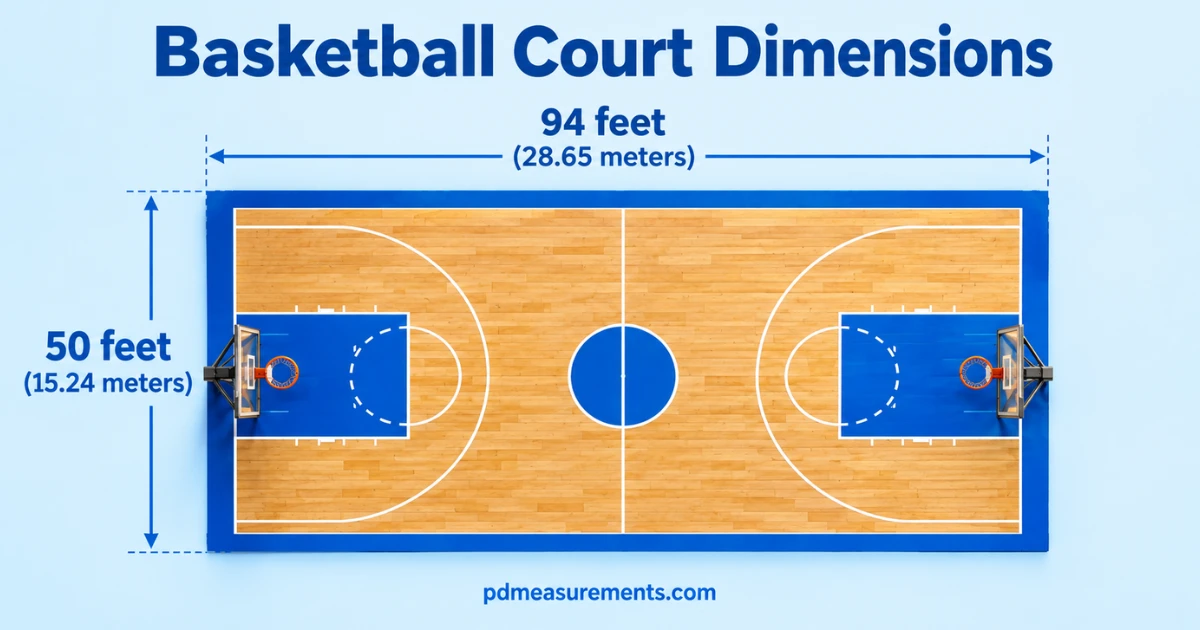
A standard basketball court measures 94 × 50 feet (28.65 × 15.24 meters) in the NBA, while a FIBA court is 28 × 15 meters (91.9 × 49.2 feet). This guide breaks down every official size, key marking, and space requirement you need — in plain, simple terms.
What Are the Standard Basketball Court Dimensions?
A standard basketball court is not one fixed size. The NBA, NCAA, FIBA, and high school courts all use slightly different measurements.
Most full-size basketball courts in the U.S. measure close to 94 feet long by 50 feet wide. International courts run a bit smaller, at 91.86 feet by 49.21 feet.
Knowing the right basketball court size matters whether you’re building a court, coaching a team, or just settling a bet with a friend.
Basketball Court Dimensions by Level of Play
NBA Basketball Court Dimensions
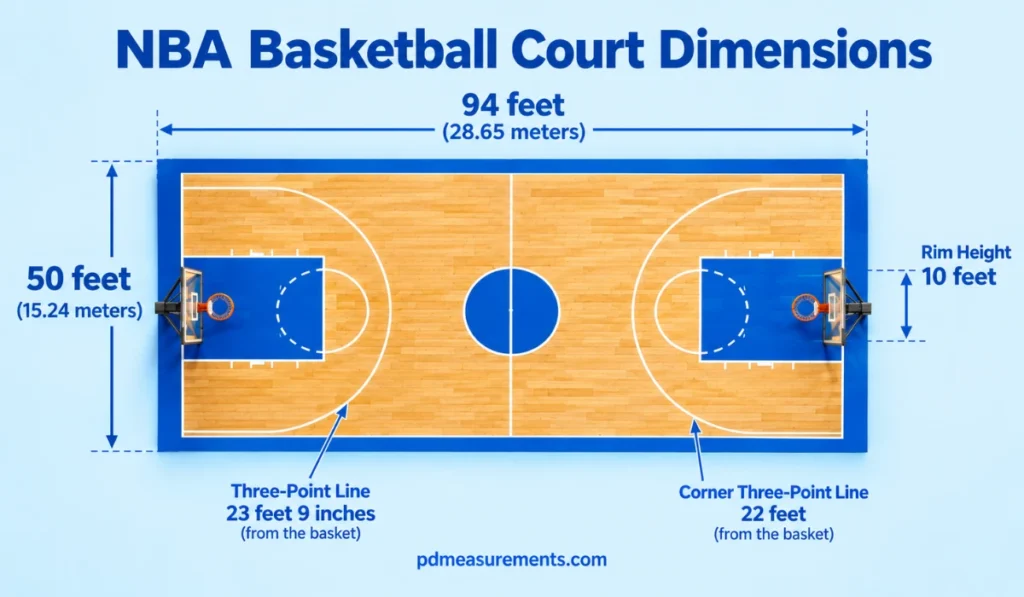
The NBA basketball court dimensions are 94 feet long by 50 feet wide (28.65 x 15.24 meters). This is the largest regulation court size used in American basketball.
The NBA rim sits 10 feet high, and the three-point line stretches 23 feet 9 inches from the basket, shrinking to 22 feet in the corners. The NBA does not require a fixed buffer zone, so extra space around the court can vary by arena.
NCAA College Basketball Court Dimensions
College basketball court dimensions match the NBA at 94 feet by 50 feet. The big difference is the key width — only 12 feet wide in college, compared to 16 feet in the NBA.
The three-point line in NCAA play sits at 20 feet 9 inches, noticeably closer than the NBA arc. This makes long-range shooting a bit easier at the college level.
More Post: Soccer Pitch Dimensions: Complete Field Size, Markings & Goal Guide
FIBA / International Basketball Court Dimensions
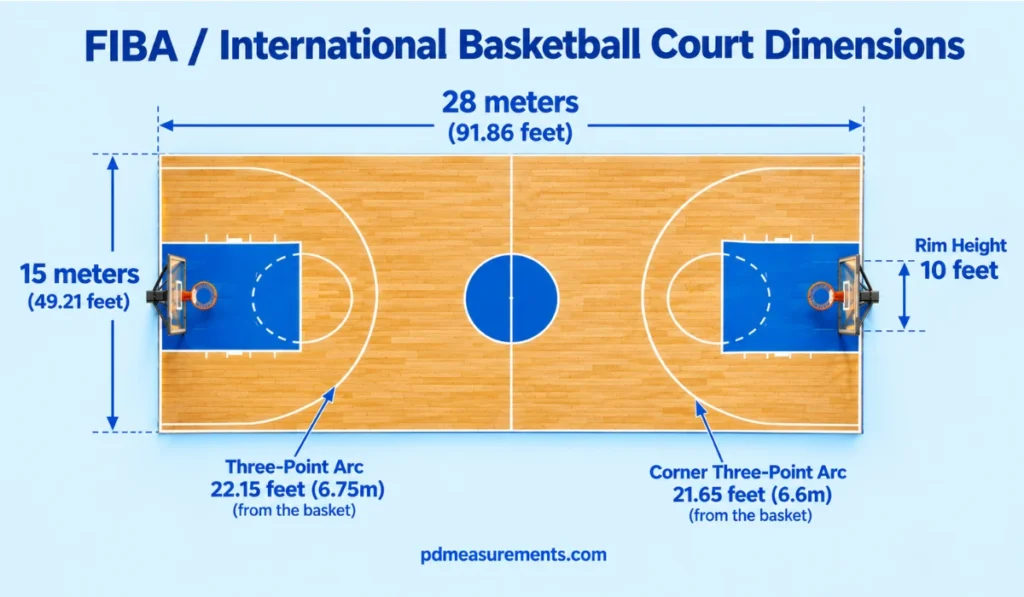
FIBA basketball court dimensions measure 28 meters by 15 meters, which converts to roughly 91.86 feet by 49.21 feet. This is the standard used in the Olympics and most basketball leagues outside the U.S.
The FIBA three-point arc sits at 22.15 feet (6.75m), dropping to 21.65 feet (6.6m) in the corners. The key is also a trapezoid shape in older FIBA courts, though most modern courts now use the rectangular NBA-style lane.
WNBA Basketball Court Dimensions
WNBA court dimensions are identical to the NBA: 94 feet by 50 feet, with a 16-foot key. The rim height stays the same too, at 10 feet.
The three-point line differs slightly, ranging between 21.65 and 22.15 feet, closer to the FIBA standard than the NBA’s.
High School Basketball Court Dimensions
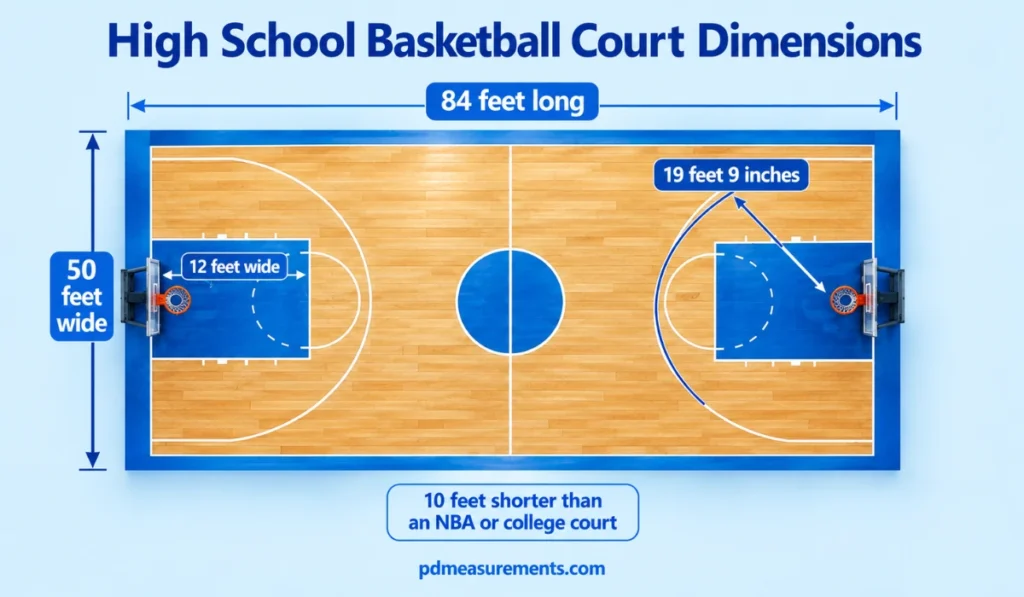
A high school basketball court measures 84 feet long by 50 feet wide. That’s a full 10 feet shorter than an NBA or college court.
The key in high school ball is 12 feet wide, matching the NCAA. The three-point line sits closer at 19 feet 9 inches from the hoop, making it the shortest arc among the major U.S. levels.
Junior High & Youth Basketball Court Dimensions
Younger players use smaller courts to match their size and skill level. A junior high basketball court is typically the same as high school: 84 feet by 50 feet.
For 4th and 5th graders, courts often shrink to 74 feet by 50 feet. For 2nd and 3rd graders, the court can be as small as 50 feet by 42 feet.
Basketball Court Size Comparison Chart
Half Court Basketball Dimensions
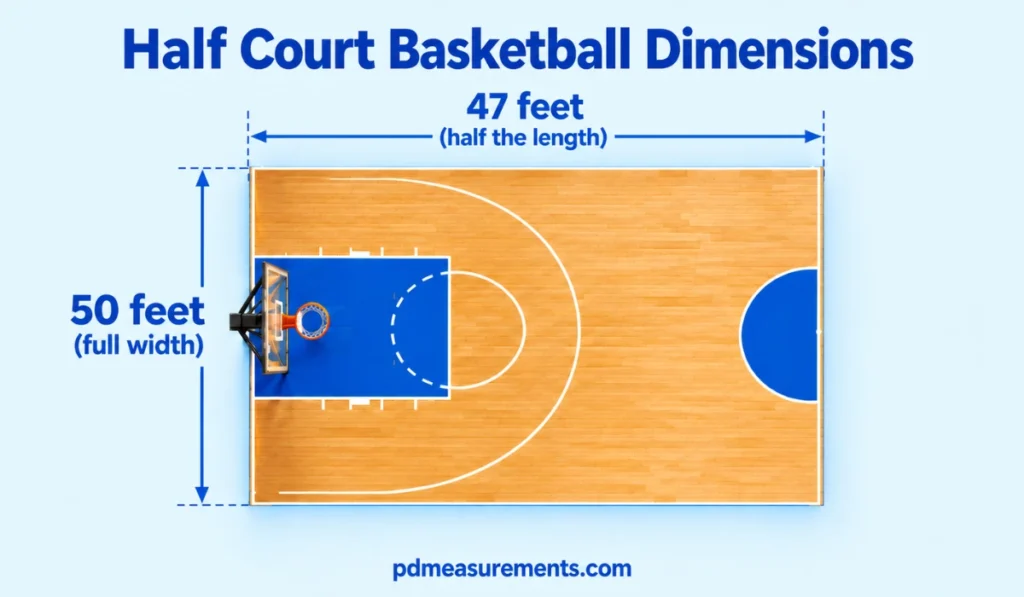
A half court basketball dimension is essentially one end of a full court. It measures 47 feet by 50 feet — half the length, full width.
Half courts are the go-to choice for backyard setups, driveways, and pickup games. They keep all the official markings — free-throw line, key, and three-point arc — without needing double the space.
3×3 Basketball Court Dimensions
3×3 basketball, now an official Olympic event, uses a smaller, single-hoop layout. The FIBA 3×3 court measures 15m x 11m (about 49 x 36 feet).
One notable difference: 3×3 courts skip the free-throw arc and instead mark a restricted area 11 meters from the baseline. This format is built for fast, half-court style play.
Key Basketball Court Markings and Measurements
Beyond the outer boundary, a basketball court is covered in lines and markings that control gameplay. Each one has an exact, regulated distance.
Free Throw Line Distance
The free throw line sits 15 feet from the backboard on every U.S. court — NBA, college, and high school alike. FIBA courts measure it slightly farther, at 15.09 feet (4.6m).
This is one of the few measurements that stays nearly identical across every level of basketball.
3 Point Line Distance From the Hoop
The 3-point line distance varies more than any other court marking. It ranges from 19’9″ in high school up to 23’9″ in the NBA.
Here’s the breakdown by level:
- High School: 19’9″
- NCAA: 20’9″
- WNBA/FIBA: 21.65’–22.15′
- NBA: 22’–23’9″
The Key / Free Throw Lane Width
The key, also called “the paint” or “the lane,” runs from the baseline to the free-throw line. It’s 16 feet wide in the NBA and FIBA, but only 12 feet wide in college and high school.
A narrower key opens up more driving lanes near the basket, which is one reason college and high school games often look more crowded under the rim.
Center Circle Dimensions
The center circle, also called the jump circle, marks where the game begins with a tip-off. NBA and NCAA courts use a 12-foot diameter circle.
FIBA’s version is slightly smaller, at 11.81 feet (3.6m) across.
No-Charge Arc / Restricted Area
The no-charge arc, or restricted area, is a small half-circle under the basket. It was added to the NBA in 1997 to stop defenders from drawing cheap fouls.
On NBA courts, this arc has a 4-foot radius from the center of the hoop.
Sidelines, Endlines & Baselines
Sidelines run the full length of the court, while endlines (also called baselines) mark the short ends behind each basket. On an NBA or college court, sidelines run 94 feet, and endlines run 50 feet.
These lines define the total playing boundary — step outside them, and the ball is out of bounds.
Backboard, Rim, and Basketball Hoop Height
Every regulation basketball hoop height sits at exactly 10 feet off the ground, no matter the league. The backboard measures 72 inches wide by 42 inches tall, with an 18-inch diameter rim.
The backboard extends about 4 feet in from the baseline, giving players room to drive and shoot from underneath.
Basketball Court Ceiling Height Requirements
How tall of a ceiling do I need for a basketball court? Most gyms and indoor courts need a minimum ceiling height of 22 to 25 feet for casual and youth play.
Competitive and professional facilities, including NBA arenas, usually build with 25 to 30+ feet of clearance. This extra height accounts for high arcing shots, lighting fixtures, and scoreboards hung above the court.
If you’re converting a garage or barn into a home court, aim for at least 16 to 18 feet, though this limits full-arc shooting near the basket.
Basketball Court Surface Types and Materials
Not every court is built the same way. The surface material affects bounce, grip, maintenance, and cost.
Hardwood (Maple) Courts
Hardwood courts, usually made from maple, are the standard for NBA and NCAA arenas. Maple offers a strong mix of durability and shock absorption, which protects players’ knees and ankles.
These courts need regular upkeep but rarely splinter or crack under normal use.
Asphalt and Concrete Courts
Asphalt and concrete courts are the most common outdoor surfaces in the U.S. You’ll find them in driveways, parks, and school playgrounds.
They’re durable and low-cost, but offer less shock absorption than wood or rubber.
Rubber Courts
Rubber courts add a cushioned layer between the concrete base and the playing surface. This improves shock absorption and reduces injury risk from falls.
Rubber surfaces also handle rain and sweat better than plain asphalt.
Modular Tile / Multi-Purpose Courts
Modular tile courts, like those from brands such as VersaCourt and OnCourt, snap together over an existing base. They offer strong grip, easy cleanup, and flexible color designs.
This surface type has become popular for backyard courts because installation is fast and doesn’t require professional paving crews.
Basketball Court Dimensions Glossary
- Key/Paint/Lane: The rectangular area under the basket where players line up for free throws.
- Baseline/Endline: The boundary line behind each basket.
- Run-off: Buffer space around the court’s playing lines.
- No-Charge Arc: Small half-circle under the hoop where offensive fouls aren’t called.
- Jump Circle: Another name for the center circle, used for the opening tip-off.
FAQs About Basketball Court Dimensions
Is 30×30 big enough for a basketball court?
A 30 × 30-foot space works for a single-hoop shooting area but isn’t large enough for a regulation half court, which requires 47 × 50 feet.
What size is a high school basketball court?
A high school basketball court measures 84 × 50 feet, which is 10 feet shorter than an NBA or college court.
How far from the rim is the 3-point line?
It depends on the league: 19′9″ (high school), 20′9″ (NCAA), ~22 feet (FIBA/WNBA), and up to 23′9″ (NBA).
How tall of a ceiling do I need for a basketball court?
Most indoor courts need at least 22–25 feet of ceiling height, while professional facilities often use 25–30+ feet of clearance.
Are high school basketball courts the same as the NBA?
No. High school courts are 84 × 50 feet, while NBA courts are 94 × 50 feet — a 10-foot difference in length.
How much does it cost to build a basketball court?
Costs range from around $3,000 for a small driveway court to $60,000+ for a full-size modular or hardwood court, depending on size and materials.

Rehmaan Khan is a Measurement Content Researcher Specializing in PD measurements, Size Guides, Charts, and Simple Educational Measurement Content.