
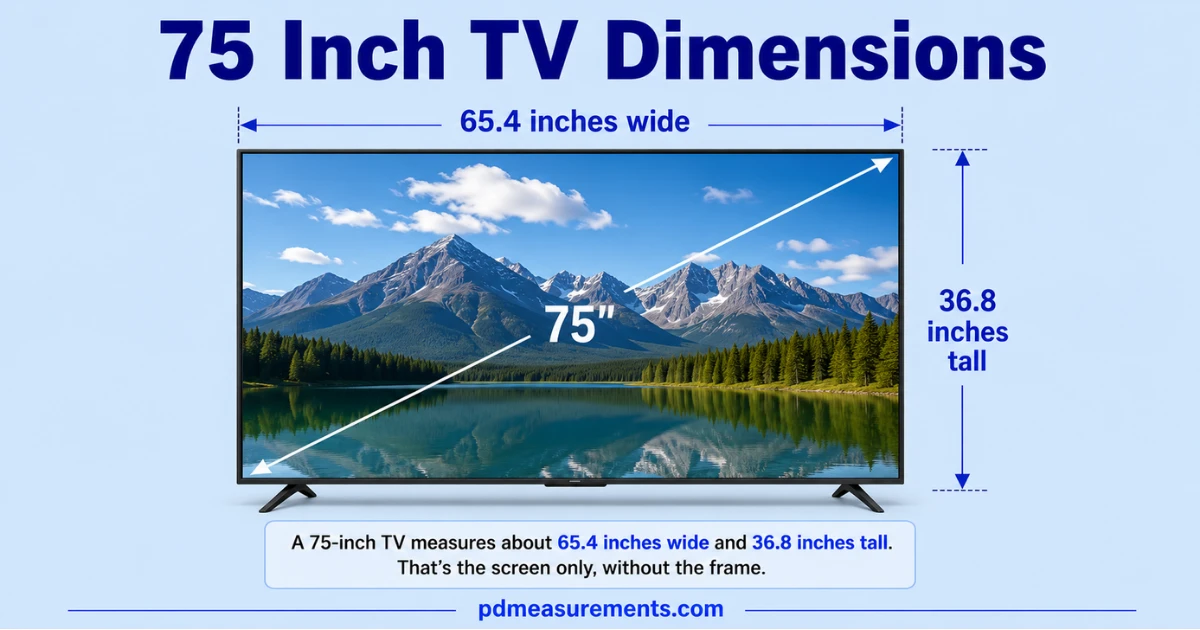
A 75-inch TV measures about 65.4 inches wide and 36.8 inches tall. That’s the screen only, without the frame.This guide covers 75 inch TV dimensions, weight, stand size, and mounting height — all in one place.
75 Inch TV Dimensions in Centimeters
In metric terms, a 75-inch screen is 166 cm wide and 93.4 cm tall. The diagonal converts to 190.5 cm.
International buyers and importers usually reference these cm figures instead of inches.
Screen Size vs. Overall TV Dimensions
TV size always refers to the diagonal screen measurement, corner to corner. It never includes the frame around the panel.
That’s why two “75-inch” TVs from different brands can have slightly different overall widths. Always check the manufacturer’s spec sheet, not just the marketing number.
How 75 Inch TV Dimensions Are Calculated
The 16:9 Aspect Ratio Explained
Aspect ratio describes the relationship between screen width and height. A 16:9 ratio means the screen is 16 units wide for every 9 units tall — the same ratio used in most streaming content and Blu-ray films.
This ratio has been the TV industry standard since the shift away from old 4:3 tube televisions.
Diagonal Measurement Formula
The math uses the Pythagorean theorem:
- Width = (Diagonal ÷ √(16² + 9²)) × 16
- Height = (Diagonal ÷ √(16² + 9²)) × 9
Plug in 75, and you get a width near 65.4 inches and a height near 36.8 inches — matching real-world spec sheets from Samsung, LG, and Sony.
75 Inch TV Dimensions by Brand and Model
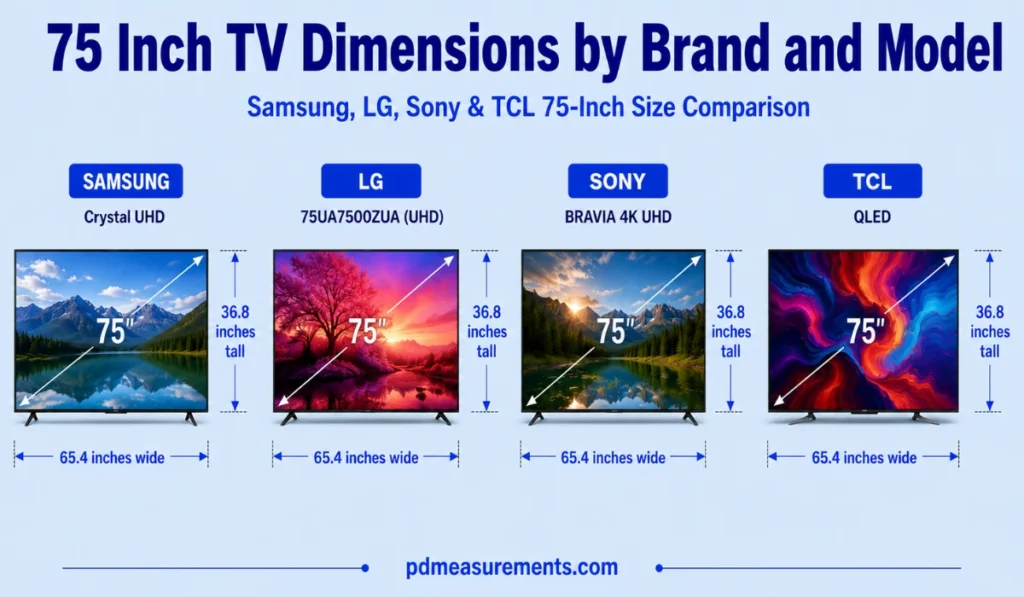
Samsung, LG, Sony & TCL 75-Inch Size Comparison
LG’s 75-inch UHD models, like the 75UA7500ZUA, list overall widths close to the 65.4-inch screen baseline, with only minor bezel additions. Samsung’s Crystal UHD and TCL’s QLED lineups follow a similar pattern.
Sony’s Bravia series tends to run slightly heavier due to thicker panel construction, though width stays nearly the same across brands.
Why Dimensions Vary Slightly Between Models
Panel technology explains most of the difference. OLED panels are thinner and lighter than LED or QLED panels of the same size.
Stand footprint also varies — some brands use a single center pedestal, others use two feet spaced wide apart. This affects the stand size you’ll need, not the screen itself.
More Post: 55 Inch TV Dimensions: Width, Height, Depth, Viewing Distance & Space
75 Inch TV Depth and Weight
Average Depth
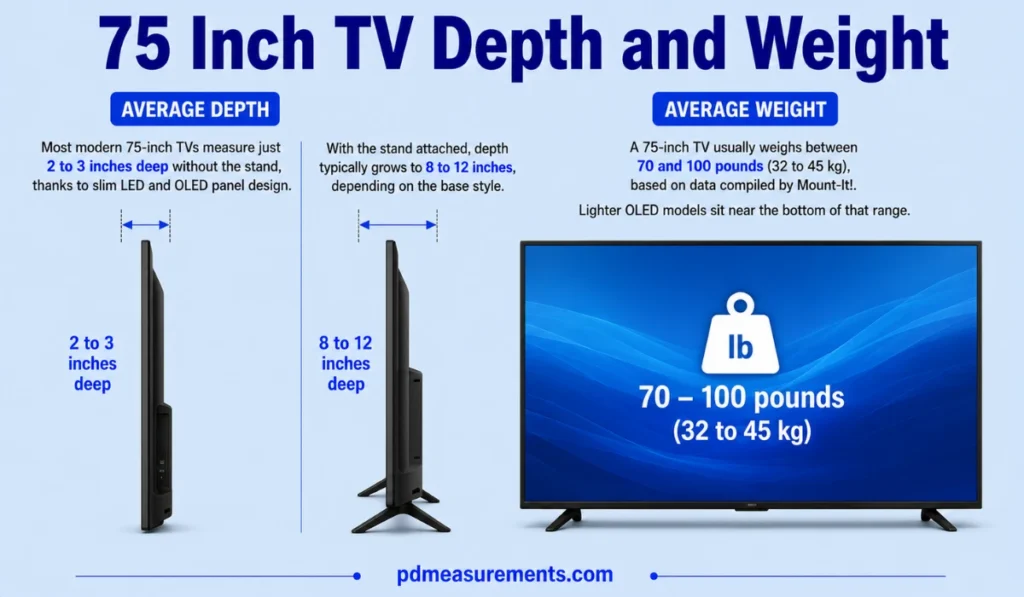
Most modern 75-inch TVs measure just 2 to 3 inches deep without the stand, thanks to slim LED and OLED panel design.
With the stand attached, depth typically grows to 8 to 12 inches, depending on the base style.
Average Weight for Shipping, Handling, and Wall Mounting
A 75-inch TV usually weighs between 70 and 100 pounds (32 to 45 kg), based on data compiled by Mount-It!. Lighter OLED models sit near the bottom of that range.
Because of this weight, installation almost always needs two people — one to hold the panel, one to secure the mount or stand.
How Much Space Do You Need for a 75 Inch TV?
Minimum Wall Space and Clearance Requirements
Leave at least 70 inches of wall width for the TV plus mounting hardware. This gives clearance for the bracket arms on a full-motion mount.
Vertical clearance should include room above the screen for ventilation, especially with LED and QLED panels that generate heat.
Recommended Room Size (Square Feet)
According to TvSize.app, a 75-inch TV fits comfortably in rooms starting around 28 square meters (about 300 square feet), with 40 square meters considered ideal for a home theater feel.
Smaller rooms can still work, but viewing distance becomes tighter.
Doorway, Hallway, and Staircase Clearance for Delivery
Before delivery day, measure your front door, hallway turns, and any staircases. A 75-inch TV box often exceeds 70 inches in one dimension.
Diagonal carrying angles through narrow hallways trip up more buyers than actual room space does.
75 Inch TV Stand Size Requirements
Ideal TV Stand Width for a 75 Inch TV
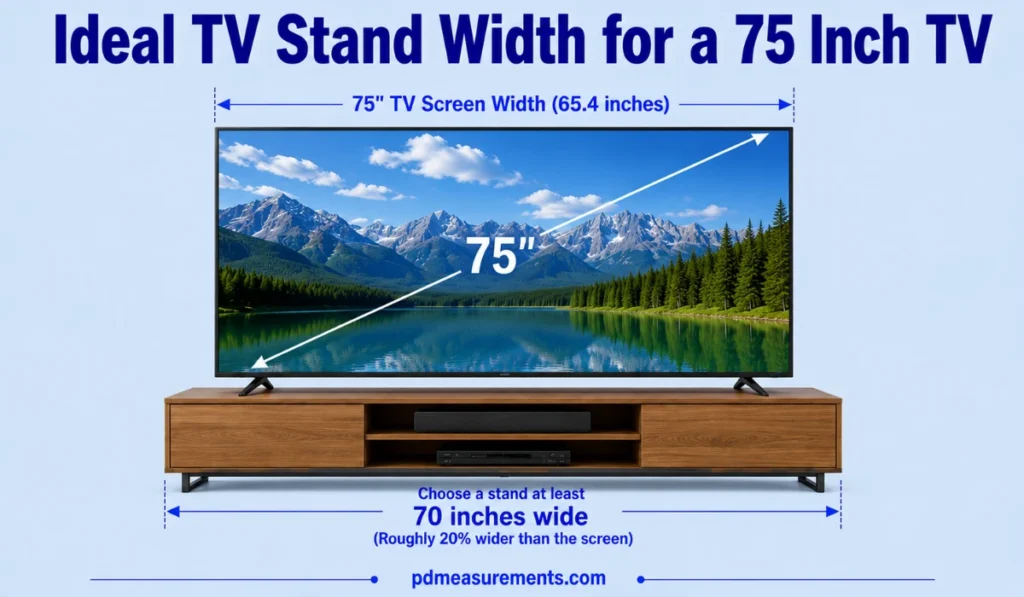
Choose a stand at least 70 inches wide — roughly 20% wider than the screen itself. This extra width, noted by Belleze, accommodates the bezel and improves visual balance.
A stand that’s too narrow looks cramped and risks tipping if bumped.
Stand Depth, Weight Capacity, and Base/Feet Spacing
Confirm the stand’s weight rating covers your TV’s full weight, plus soundbar or speakers if you’re adding them.
Measure your TV’s feet spacing before buying — some stands have narrow tops that won’t fit widely spaced legs.
75 Inch TV Wall Mount Size and VESA Requirements
VESA Pattern for 75 Inch TVs
VESA pattern refers to the screw-hole spacing on the back of your TV, measured in millimeters. Most 75-inch TVs use a VESA pattern between 400x400mm and 600x400mm.
Always check your exact model’s VESA spec before buying a mount — patterns aren’t universal across brands.
Wall Stud Spacing and Mounting Hardware Considerations
Given the weight of a 75-inch TV, mounts must anchor into wall studs, not drywall alone. Standard stud spacing is 16 inches on center in most US homes.
Choose a mount rated for at least the TV’s full weight, with extra capacity built in for safety margin.
Ideal Viewing Distance for a 75 Inch TV
Recommended Distance in Feet (4K vs. Full HD)
For 4K resolution, the optimal viewing distance for a 75-inch screen runs between 9.5 and 15.5 feet. This range follows both SMPTE (daily viewing) and THX (immersive/cinema) standards.
Full HD sets need more distance — closer to 12.5 to 19 feet — since lower resolution looks pixelated up close.
Optimal Mounting Height for a 75 Inch TV
How to Calculate Eye-Level Mounting Height
The goal: center of the screen at eye level when seated. For most rooms, this places the TV’s bottom edge around 24 inches from the floor, with the screen center near 42 inches.
To personalize this, measure your seated eye height, then subtract half the TV’s height (about 18.4 inches for a 75-inch screen).
Adjusting Height for Fireplace Walls or Soundbars
Mounting above a fireplace often pushes the screen higher than ideal, causing neck strain. A tilting mount helps angle the screen downward to compensate.
If adding a soundbar below the TV, factor in extra clearance so it doesn’t block the lower edge of the picture.
75 Inch TV Size Comparison to Other TV Sizes
Context helps when deciding if 75 inches is the right fit.
75 Inch vs. 65 Inch TV Dimensions
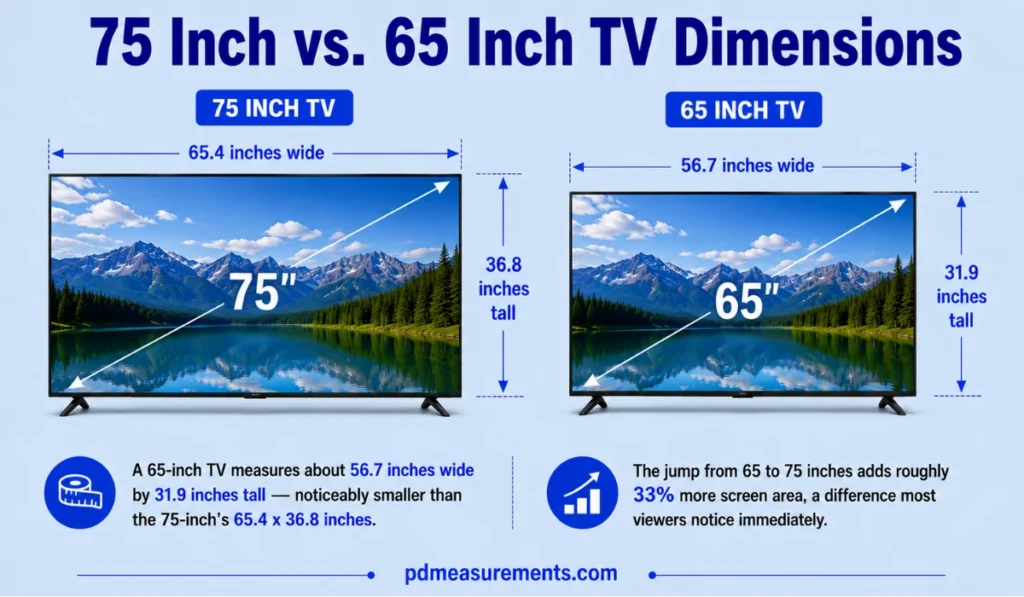
A 65-inch TV measures about 56.7 inches wide by 31.9 inches tall — noticeably smaller than the 75-inch’s 65.4 x 36.8 inches.
The jump from 65 to 75 inches adds roughly 33% more screen area, a difference most viewers notice immediately.
75 Inch vs. 85 Inch TV Dimensions
An 85-inch TV stretches to about 74 inches wide, nearly 9 inches wider than a 75-inch model.
Many buyers consider 75 inches the “sweet spot” — large enough for immersive viewing, but still practical for standard living rooms.
Pros and Cons of a 75 Inch TV
Every screen size involves tradeoffs.
Benefits of a 75 Inch TV
A 75-inch screen delivers a genuine home theater experience without needing a dedicated media room. It also suits group viewing for sports, gaming, and movie nights.
Modern 4K and 8K resolution scales beautifully at this size, showing sharp detail even up close.
Drawbacks to Consider Before Buying
The biggest drawback is weight and handling — moving or mounting a 75-inch TV alone isn’t practical. Delivery and installation logistics also take more planning than smaller sets.
Smaller rooms may struggle to hit the recommended viewing distance, which can cause eye strain if seating sits too close.
Frequently Asked Questions About 75 Inch TV Dimensions
How big is a 75-inch TV compared to a person?
A 75-inch TV measures 36.8 inches tall — about chest-to-shoulder height on an average adult. Its 65.4-inch width is close to the wingspan of someone around 5’6″ tall.
Is there a big difference between a 65 inch and a 75-inch TV?
Yes. A 75-inch screen offers about 33% more viewing area than a 65-inch model. The width gap alone is nearly 9 inches, which is noticeable in most living rooms.
How much space is required for a 75-inch TV?
You need at least 70 inches of wall width for mounting hardware, plus a room deep enough to allow 9.5 to 15.5 feet of viewing distance for comfortable 4K viewing.
How much taller is a 75 TV than a 65?
A 75-inch TV stands about 4.9 inches taller than a 65-inch model (36.8 inches vs. 31.9 inches). That extra height makes a visible difference on a stand or wall.
Is a 75 TV too big for a living room?
Not usually. Most living rooms over 300 square feet handle a 75-inch TV comfortably, as long as seating sits within the recommended viewing distance range.
What are the disadvantages of a 75-inch TV?
The main downsides are weight (70–100 lbs), the need for two people during installation, higher upfront cost, and the requirement for enough room to hit ideal viewing distance without eye strain.

Rehmaan Khan is a Measurement Content Researcher Specializing in PD measurements, Size Guides, Charts, and Simple Educational Measurement Content.