
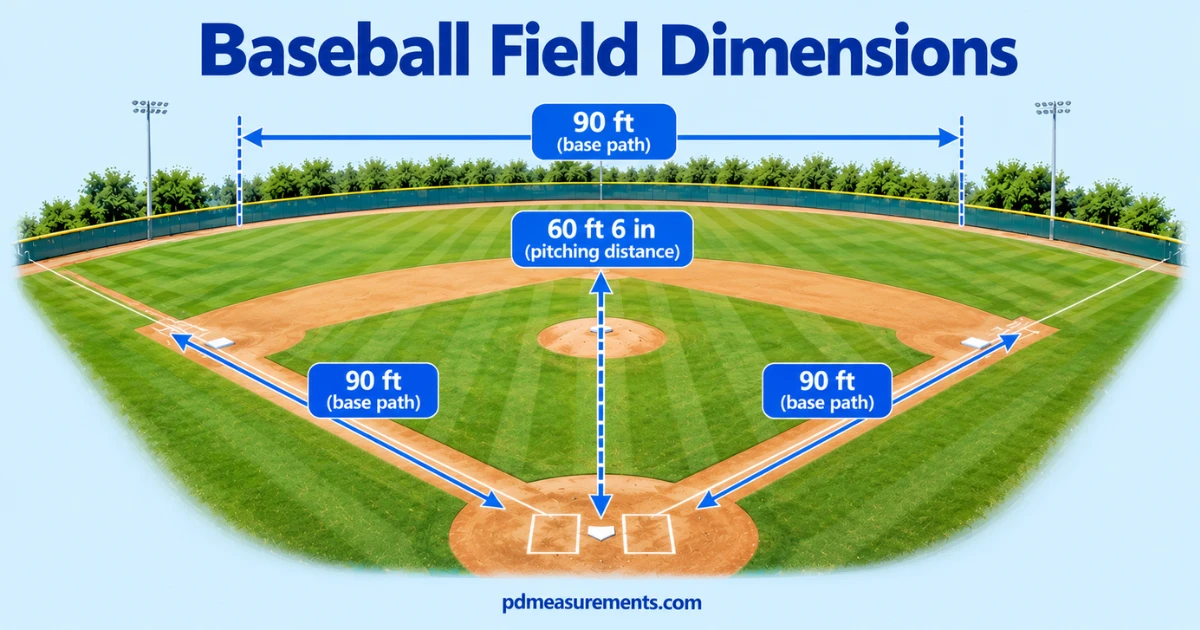
A standard MLB/high-school baseball field has 90-foot base paths and a 60 ft 6 in pitching distance from home plate to the pitching rubber.This guide breaks down every measurement you need — from Pinto to the pros — plus the answers to the questions players and parents ask most.
Baseball Field Dimensions by League and Age Group
Baseball field dimensions scale up as players get older. A 90-foot baseline works for a pro athlete, but it would swallow a 9-year-old whole.
That’s why USA Baseball, Little League, and the NFHS all use a graduated field system — bigger diamonds unlock as arm strength and speed grow.
Baseball Field Dimensions Chart (Pinto to MLB)
This table is the fastest way to compare baseball field dimensions by age, and it’s the one number set every coach, parent, and groundskeeper keeps saved.
Little League Baseball Field Dimensions (Ages 9–12)
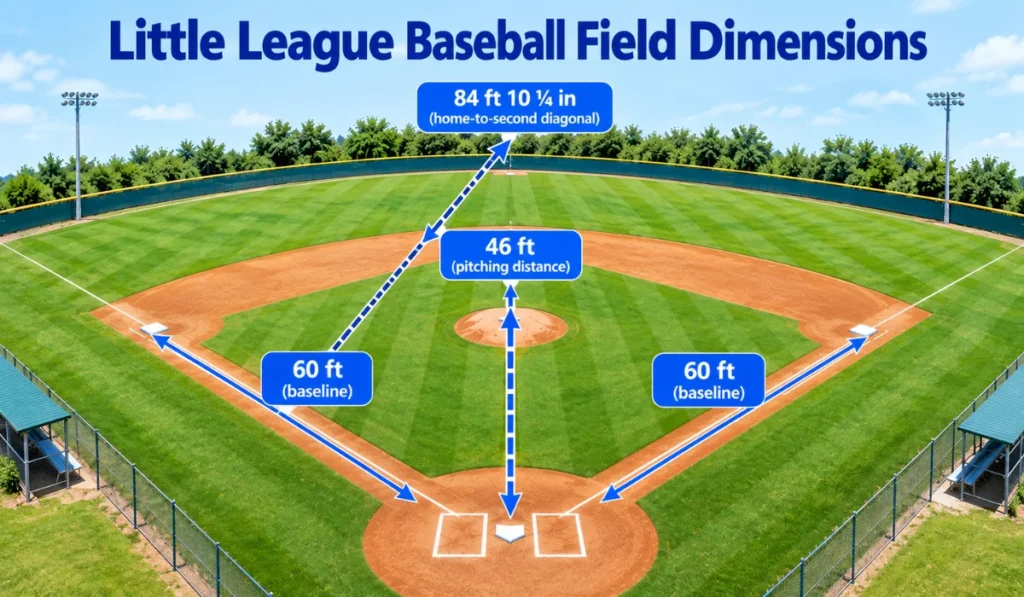
Little League fields use a 60-foot baseline, according to Little League International’s official rulebook. The home-to-second diagonal comes out to 84 feet, 10 ¼ inches.
The pitcher’s mound sits 46 feet from home plate — nearly 15 feet closer than the pro standard, which keeps pitch speed manageable for young arms.
High School, College, and MLB Baseball Field Dimensions (90 ft Base)
Once players hit high school, the field jumps to the full 90-foot diamond. This is the same layout used in NCAA, NFHS, and Major League Baseball.
The pitching rubber sits 60 feet 6 inches from home plate. That single number hasn’t changed since 1893 — it’s one of the oldest fixed measurements in American sports.
How Baseball Field Dimensions Scale by Age
Baseball field size isn’t random. It’s built around biomechanics — reaction time, arm strength, and sprint speed all grow at predictable rates.
A 12-year-old on Little League’s Majors division plays a 60-foot baseline field. That’s the largest youth diamond before players graduate to Intermediate (50/70) or full-size fields.
How to Measure and Set Up a Baseball Field
Laying out a regulation baseball field starts at one fixed point: home plate. Every other measurement radiates from there.
Get the first two points wrong, and the whole diamond drifts out of square — which is why groundskeepers double-check every diagonal.
Placing Home Plate and the Baselines
Start by anchoring home plate, then run a string toward the pitcher’s mound to set your center line. The baseline length depends on your league — 60 ft for Little League, 90 ft for high school and up.
Chalk each baseline in a straight run from home to first, and home to third.
Squaring the Infield (Home-to-Second Diagonal)
This is the step most fields get wrong. Measure the home-to-second diagonal — 127 ft 3 ⅜ in on a 90-ft diamond — to confirm your square is true.
If the diagonal is off by even a few inches, re-anchor and remeasure before you paint a single line.
Setting the Pitcher’s Mound and Rubber
The pitching rubber sits at the exact center of the infield square, measured along the home-to-second line. At the pro and high school level, that’s 60 ft 6 in from the back tip of home plate.
The mound itself rises 10 inches above home plate and spans 18 feet across.
Marking Foul Lines and the Outfield Arc
Run your foul lines from home plate through first and third base, extending them all the way to the outfield fence. Then arc the infield dirt from the pitching rubber at a radius matching your baseline.
This arc is what separates the infield skin from the grass — get the radius wrong and your infield looks lopsided from the stands.
Pitcher’s Mound, Batter’s Box, and Infield Specs
Beyond the base paths, a handful of smaller measurements make or break how a field plays. These are the details first-time field builders miss most often.
Pitcher’s Mound Height and Diameter by Level
At the high school, college, and MLB level, the mound is 18 feet in diameter and raised 10 inches above home plate, per official rules. Youth mounds shrink to 10–12 feet across with a 6-inch rise.
That extra elevation is what lets pitchers generate downhill leverage on every pitch.
Batter’s Box and On-Deck Circle Dimensions
The standard batter’s box measures 4 ft wide by 6 ft long at MLB, NCAA, and NFHS levels. Youth leagues trim that to 3 ft wide.
The on-deck circle, where the next hitter warms up, is a simple 5-foot-diameter circle near the dugout.
Base Size and Infield Arc Radius
Every base — first, second, and third — measures 18 by 18 inches square. The infield arc radius matches the baseline distance, so a 90-ft diamond gets a 95-ft skin radius.
These numbers stay identical across every MLB stadium, even when the outfield fences don’t.
Outfield Fences, Warning Track, and MLB Ballpark Variations
Here’s where baseball field dimensions stop being uniform. Unlike football or basketball, MLB lets every team design its own outfield.
That single rule is why no two Major League ballparks play the same.
Foul Pole to Foul Pole Distance Explained
There’s no single fixed number for pole-to-pole distance, because it depends on how far each foul pole sits from home plate and the shape of the arc between them. MLB rules require at least 325 feet down the lines and 400 feet to center for parks built after June 1958.
In practice, most MLB fields run 300–355 feet down the lines and 390–435 feet to dead center, according to CoverSports’ MLB dimensions guide.
More Post: Car Garage Dimensions: Standard Sizes for 1, 2, 3, and 4-Car Garages
Warning Track Width and Purpose
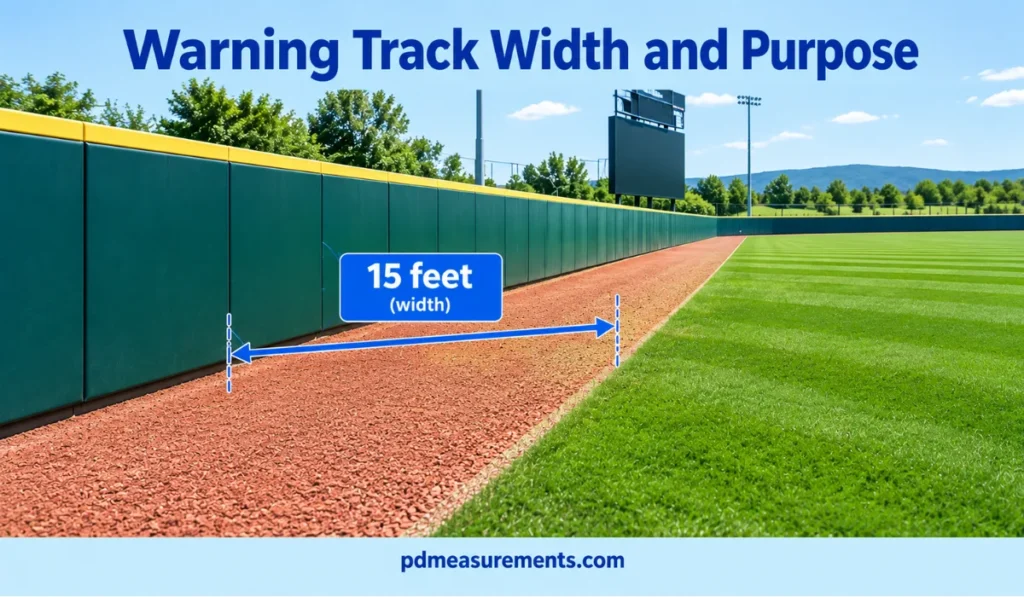
The warning track is a strip of crushed brick, gravel, or dirt running along the base of the outfield fence. At the MLB and NCAA level, it’s typically 15 feet wide.
Outfielders feel the texture shift underfoot, which warns them the wall is close — without forcing them to take their eyes off the ball.
Which MLB Team Has the Smallest Outfield?
Fenway Park holds this title. The Boston Red Sox’s home field measures just 302 feet down the right-field line — the shortest fence distance in Major League Baseball, per CoverSports.
Left field compensates with the 37-foot Green Monster, one of the tallest outfield walls in the sport — turning would-be home runs into off-the-wall doubles.
Why No Two MLB Fields Are the Same Size
MLB is one of the only major sports where outfield dimensions aren’t standardized. Football fields are always 300 ft long. Basketball courts are always 94 by 50 ft.
Baseball teams get to shape their outfield around the land they have — a quirk that dates back to early 1900s ballparks squeezed into city blocks.
Baseball Field Dimensions vs. Softball and Cricket
Bat-and-ball sports look similar from a distance, but the field geometry varies enormously once you measure it.
Baseball vs. Softball Field Dimensions
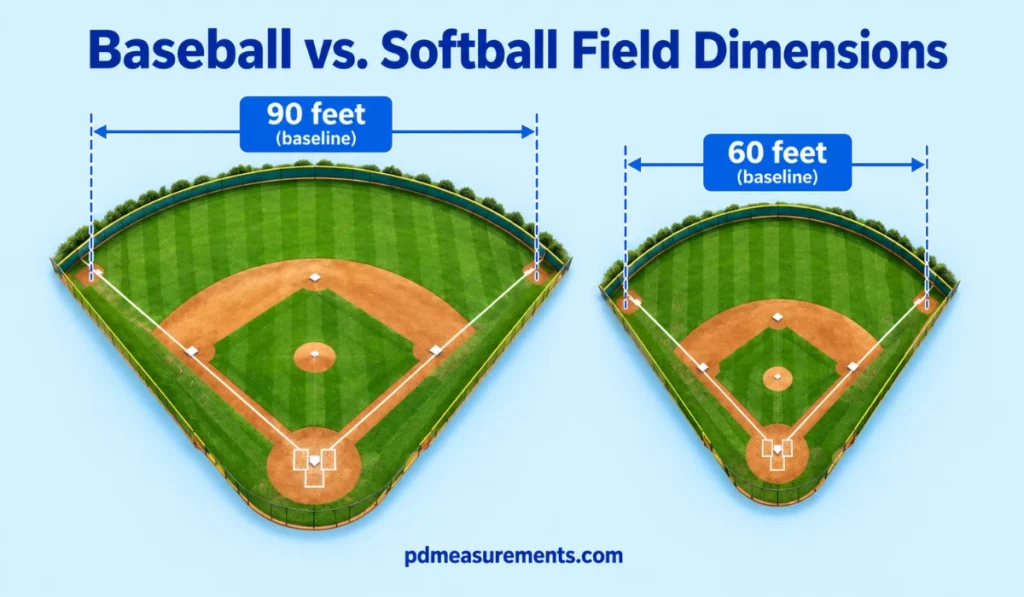
Softball uses a smaller diamond across the board. The baseline shrinks to 60 feet, and pitching distance drops to 35–43 feet depending on league and age group.
Softball also skips the raised mound entirely — pitchers throw underhand from a flat circle instead.
Baseball Field vs. Cricket Field: Key Differences
A cricket field is a completely different shape — oval, not diamond, with no foul territory at all. Cricket grounds typically measure 137 to 150 meters (450–500 ft) in diameter, according to Wikipedia’s cricket field entry.
That’s noticeably larger than a baseball outfield, where MLB’s minimum distance to the fence sits around 325 ft down the lines. The other big difference: cricket’s 22-yard pitch sits in the center of the oval, while baseball’s action is boxed inside a 90-degree diamond.
FAQs About Baseball Field Dimensions
How big is a 12-year-old baseball field?
A 12-year-old playing Little League’s Majors division uses a 60-foot baseline, a 46-foot pitching distance, and an outfield fence between 200 and 225 feet.
How big is a cricket field vs. baseball field?
A cricket field is oval-shaped and runs 137–150 meters (450–500 ft) across. A baseball field is diamond-shaped, with outfield fences starting around 325 ft down the lines at the pro level.
How far is pole to pole on a baseball field?
There’s no single fixed distance, since outfield shape varies by stadium. MLB rules require at least 325 ft down each foul line and 400 ft to center for newer parks.
What is the 80/20 rule in baseball?
The 80/20 rule in baseball applies the Pareto Principle — about 80% of results come from 20% of skills, mainly pitching and hitting.
Who has the smallest outfield in MLB?
Fenway Park, home of the Boston Red Sox, has the smallest outfield in MLB, with just 302 feet down the right-field line.
How big is a normal MLB field?
A standard MLB field has 90-foot baselines and a 60 ft 6 in pitching distance. Outfields typically range from 325–350 ft down the lines and 390–420 ft to center.
Why are donuts not allowed in Little League?
Little League banned traditional batting donuts for safety, as they could fly off bats during warm-ups. Weighted bat sleeves are allowed instead.

Rehmaan Khan is a Measurement Content Researcher Specializing in PD measurements, Size Guides, Charts, and Simple Educational Measurement Content.