
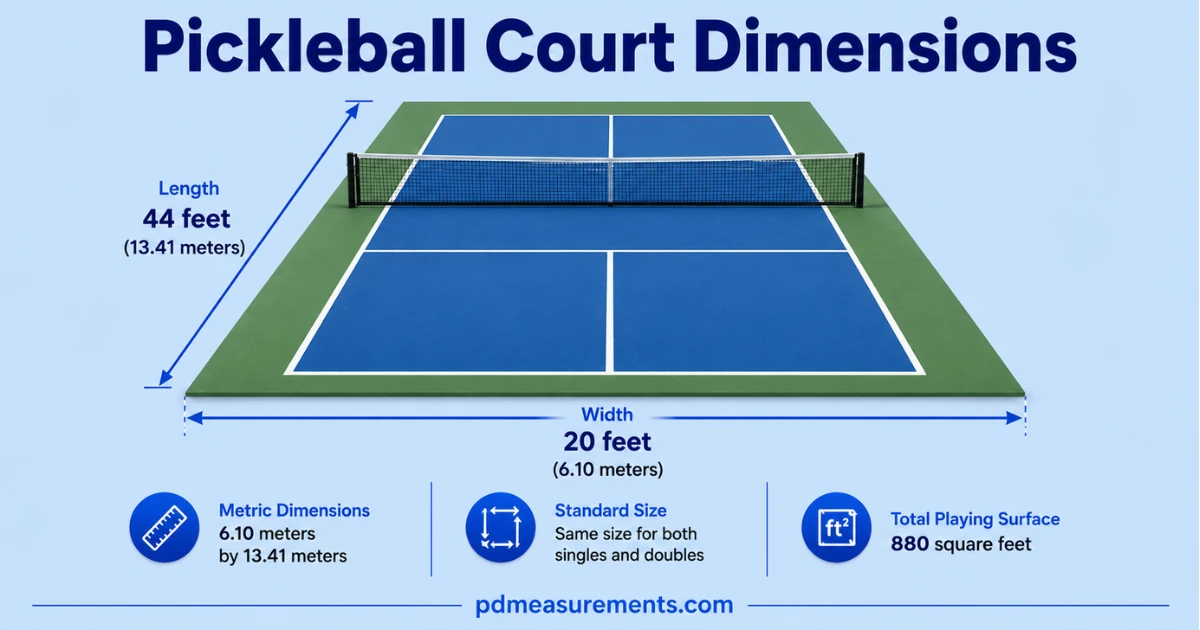
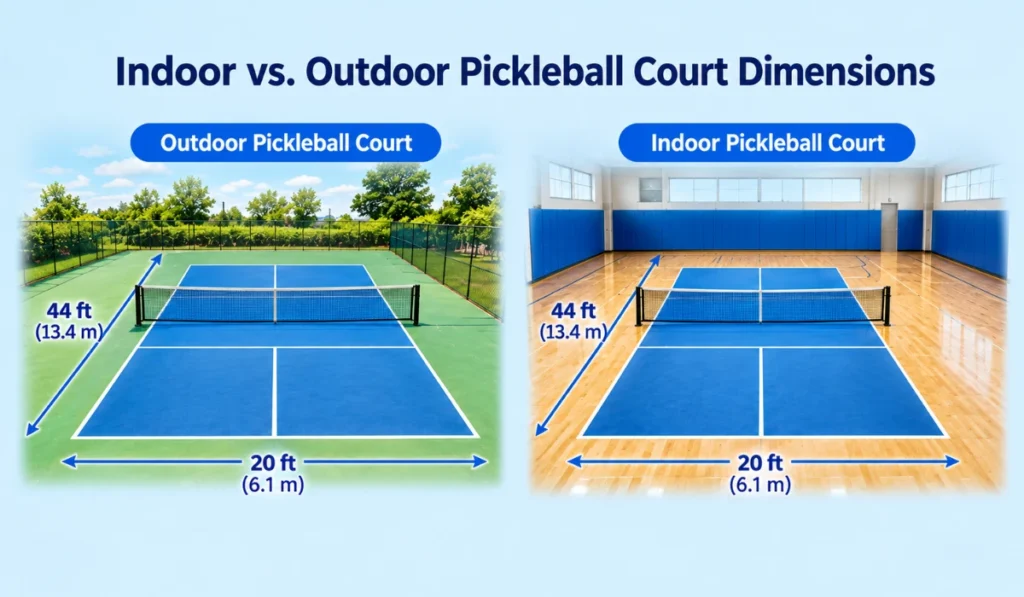
A regulation pickleball court measures 20 feet wide by 44 feet long. That’s the same size whether you’re playing singles or doubles. USA Pickleball, the sport’s governing body, sets this as the official standard.In metric terms, that’s 6.10 meters by 13.41 meters. The total playing surface works out to 880 square feet.
What Are the Official Pickleball Court Dimensions?
A regulation pickleball court measures 20 feet wide by 44 feet long. That’s the same size whether you’re playing singles or doubles. USA Pickleball, the sport’s governing body, sets this as the official standard.
In metric terms, that’s 6.10 meters by 13.41 meters. The total playing surface works out to 880 square feet.
Pickleball Court Size in Feet and Meters
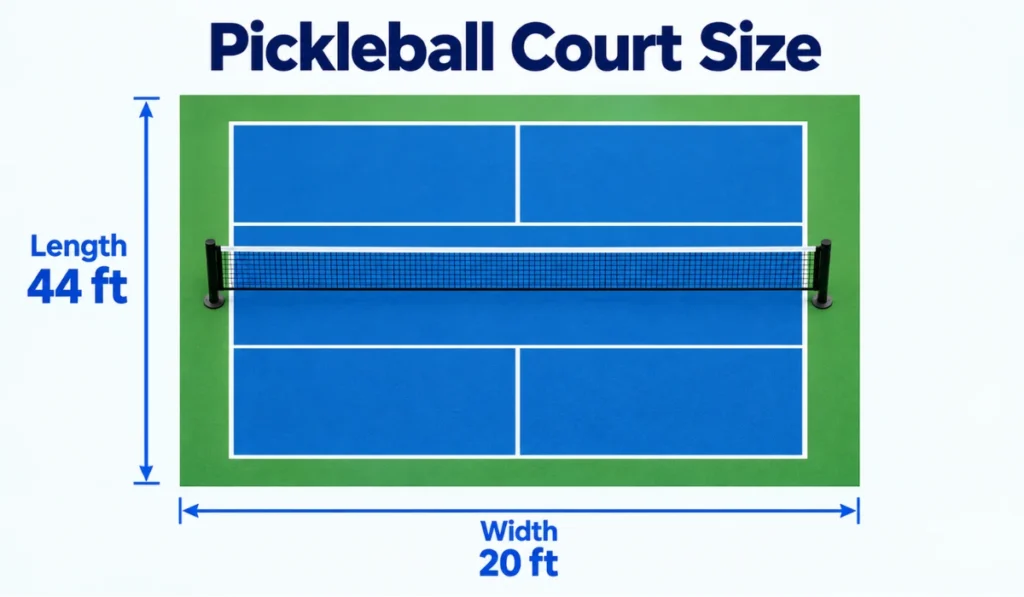
Here’s the quick math: 20 ft × 44 ft = 880 sq ft. Convert that to metric and you get roughly 82 square meters. This number stays fixed — it never changes between age groups or skill levels.
Singles vs. Doubles Court Dimensions
Unlike tennis, where doubles courts are wider than singles courts, pickleball uses one court size for both. Only the serving rules and positioning change. This is one reason pickleball courts are so easy to build and convert — there’s no need to plan for two different layouts.
Total Space Needed for a Pickleball Court
The 20×44 playing surface is only part of the story. You need extra room around the lines so players don’t crash into fences chasing a lob.
Minimum Recommended Footprint (30′ x 60′)
USA Pickleball’s rulebook calls for a minimum total space of 30 feet by 60 feet per court. That extra buffer — called run-off space — gives players room to move safely without stepping off the surface.
Preferred/Tournament Footprint (34′ x 64′)
For tournament-grade or club courts, 34 feet by 64 feet is the preferred size. This wider footprint reduces ball crossovers between neighboring courts and gives officials and spectators room to stand.
Square Footage Breakdown
At the minimum size, you’re looking at 1,800 square feet total per court (30×60). At the preferred size, that climbs to 2,176 square feet (34×64). Budget for the larger number if space allows — it pays off in comfort and safety.
Pickleball Court Layout and Key Zones
The Kitchen (Non-Volley Zone) Explained
The kitchen, officially called the non-volley zone (NVZ), is a 7-foot strip on each side of the net. Players cannot volley — hit the ball out of the air — while standing inside this zone. This rule is unique to pickleball and shapes the entire strategy of the game, especially the popular third-shot drop.
Service Areas and Center Line
Beyond the kitchen, each half-court splits into two service boxes, each measuring 10 feet by 15 feet. A center line divides them, and serves must land diagonally in the opposite box, similar to tennis.
Baselines and Sidelines
The baseline sits 22 feet from the net on each side, forming the back edge of the court. Sidelines run the full 44-foot length, marking the court’s outer width.
Line Width and Color Standards
Regulation lines are 2 inches wide, usually painted white or another high-contrast color. Thicker lines can cause confusion on close calls, so sticking to spec matters more than it seems.
More Post: Ping Pong Table Dimensions: Official Size, Width & Height Guide
Pickleball Net Dimensions and Height
Net Height at Sidelines vs. Center
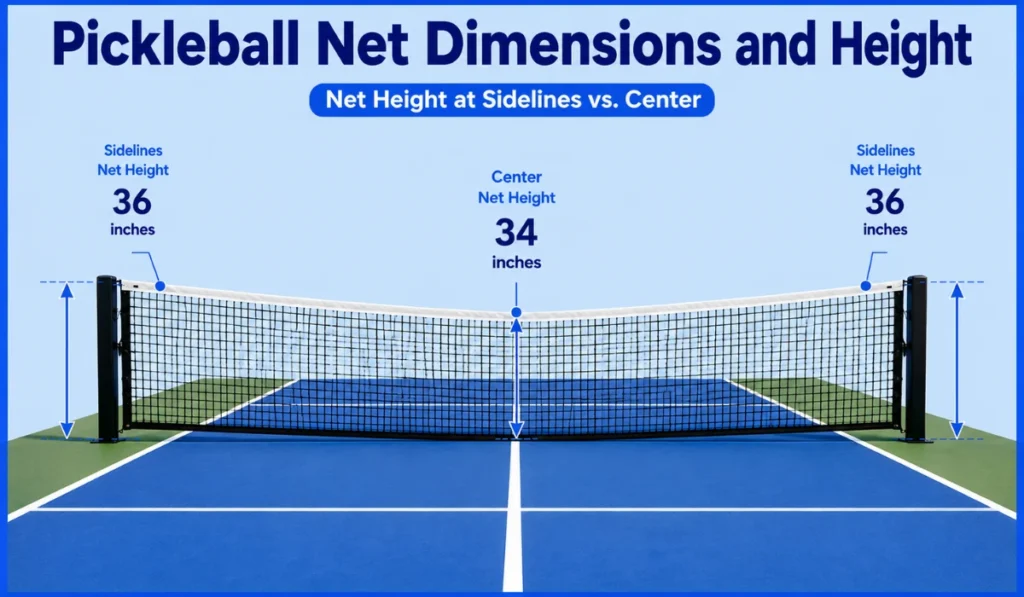
The net stands 36 inches tall at the sidelines and dips to 34 inches at the center. That two-inch sag encourages more aggressive net play in the middle of the court.
Portable vs. Permanent Net Systems
Portable nets work well for shared spaces like converted tennis courts. Permanent net systems suit dedicated facilities where consistent tension and height matter for competitive play.
Pickleball Court Dimensions vs. Other Sports Courts
Pickleball Court Size vs. Tennis Court
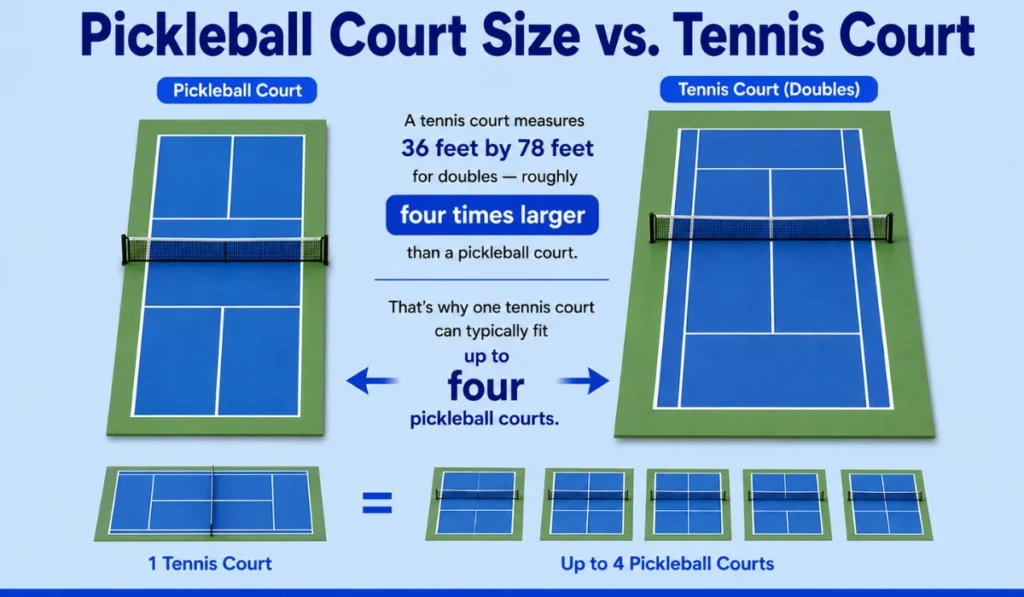
A tennis court measures 36 feet by 78 feet for doubles — roughly four times larger than a pickleball court. That’s why one tennis court can typically fit up to four pickleball courts.
Pickleball Court Size vs. Badminton Court
A doubles badminton court measures 20 feet by 44 feet — the exact same footprint as pickleball. This overlap is why many gyms and clubs convert badminton courts for pickleball with minimal changes.
Can a Pickleball Court Fit on a Half Basketball Court?
Yes, in most cases. A regulation basketball court runs 50 feet by 94 feet, so half a court (50×47) comfortably fits one 20×44 pickleball court with modest run-off space. It’s a common and budget-friendly conversion for schools and rec centers.
How to Convert an Existing Court to Pickleball Dimensions
Converting a Tennis Court (1, 2, and 4-Court Layouts)
You can mark one court using the tennis net as your center reference, two courts using the tennis sidelines as center lines, or four courts using the service box edges as boundaries. Four-court layouts pack the most value into one tennis court but require the most precise measuring.
Converting a Basketball Court
Basketball courts offer a hard, flat surface that’s already ideal for pickleball. You’ll just need temporary or painted lines and a portable net system, since basketball courts don’t come with net posts.
Marking Temporary vs. Permanent Lines
Painter’s tape or chalk works for casual, temporary setups. Line-marking paint applied with a proper machine creates a durable, permanent court that holds up through a full season.
How to Build a Backyard Pickleball Court
How Much Space Do You Need to Build a Pickleball Court?
You need a minimum flat area of 30 feet by 60 feet for a comfortable backyard court. If space is tight, you can technically play on just the 20×44 surface, but expect balls to run off the edges often.
How Far a Pickleball Court Should Be From a House
There’s no single legal number nationwide, but real-world data offers guidance. Denver Parks and Recreation built new courts roughly 400 feet from the nearest homes after noise complaints forced them to close others that sat under 100 feet away. For backyard builds, aim for at least 100–150 feet from any home — yours or a neighbor’s — plus a fence or vegetation buffer to soften sound.
Choosing the Right Surface (Concrete, Asphalt, Modular Tile)
Post-tensioned concrete offers the best long-term durability and crack resistance. Asphalt with an acrylic coating costs less upfront. Modular sport tiles are popular for DIY builds since they reduce joint stress and install without heavy equipment.
Court Orientation and Sun Positioning
Orient your court north-south where possible. This keeps the sun out of players’ eyes during the morning and late afternoon, which is when most casual games happen.
Pickleball Court Cost
What Is the Cheapest Way to Make a Pickleball Court?
The cheapest method is restriping an existing flat surface — like a driveway, tennis court, or basketball court — using painter’s tape or temporary line markers and a portable net. This can cost as little as $50–$150 in equipment, versus tens of thousands for a new dedicated build.
DIY Court Cost vs. Professional Installation
A DIY backyard court using existing concrete and modular tiles can run $3,000–$10,000. A fully professional build with excavation, fencing, and lighting can exceed $25,000–$40,000, depending on region and site conditions.
Cost by Surface Type
Acrylic-coated asphalt tends to be the most budget-friendly permanent surface. Modular tile systems sit in the mid-range. Post-tensioned concrete is the priciest but lasts the longest with the least maintenance.
More Post: Queen Bed Dimensions: Size, Types, Room Space & Mattress Thickness
Indoor vs. Outdoor Pickleball Court Dimensions
Surface Differences
Outdoor courts typically use acrylic-coated asphalt or concrete. Indoor courts favor hardwood gym floors, cushioned vinyl, or modular sport tile for better traction and joint comfort.
Lighting Requirements
Outdoor recreational courts need roughly 30–50 foot-candles of even lighting for safe night play. Indoor gyms should use diffused fixtures to avoid glare and shadows on the ball.
FAQ’s About Pickleball Court Dimensions
Can a pickleball court fit on a half basketball court?
Yes. A half basketball court (roughly 50×47 feet) comfortably fits one 20×44 pickleball court with room for basic run-off space.
What city is outlawing pickleball?
Carmel, California, permanently banned pickleball at its only public court in November 2025 due to noise complaints. Denver, Colorado, has also closed several courts for similar reasons.
How much space do you need to build a pickleball court?
You need a minimum of 30 feet by 60 feet for comfortable play, though the court’s actual playing surface is only 20 feet by 44 feet.
How far should a pickleball court be from a house?
There’s no universal legal standard, but cities like Denver now build courts roughly 400 feet from homes after noise issues forced closures of courts under 100 feet away. Aim for at least 100–150 feet for backyard builds.
What is the new sport replacing pickleball?
Pickleball hasn’t been replaced — it’s still the fastest-growing U.S. sport for four years running. Padel and roundnet (Spikeball) are the two sports gaining the most ground alongside it.
What is the cheapest way to make a pickleball court?
Restriping an existing flat surface, like a driveway or basketball court, with painter’s tape and a portable net is the cheapest option, often costing under $150.

Rehmaan Khan is a Measurement Content Researcher Specializing in PD measurements, Size Guides, Charts, and Simple Educational Measurement Content.